


A.I. [5/10]
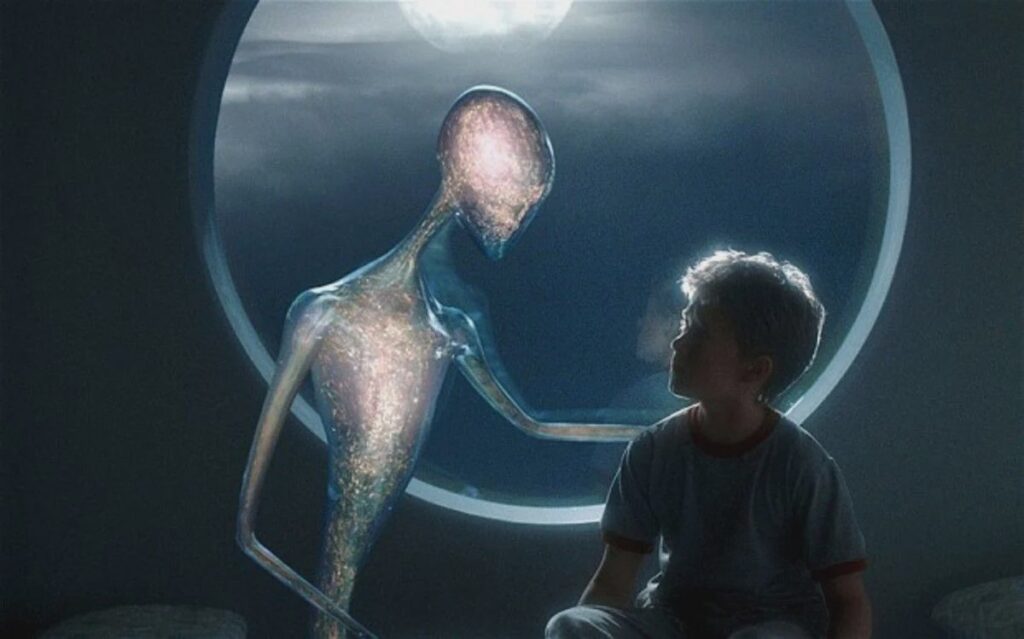
aka A.I. Artifical Intelligence : USA 2001
director : Steven Spielberg
script : Spielberg, based on a screen story by Ian Watson, from short story Super-toys Last All Summer Long by Brian Aldiss
producers include : Spielberg
cinematography : Janusz Kaminski
editing : Michael Kahn
music : John Williams
lead actors : Haley Joel Osment, Jude Law, Frances O’Connor, William Hurt
145 minutes
Artificial sunlight was growing long and golden across the lawn and David and Teddy were staring through the window at them.
Seeing their faces, Henry and his wife grew serious.
What do we do about them?
Teddy’s no trouble. He works well.
Brian Aldiss, Super-Toys Last All Summer Long
First things first: A.I. isn’t much good. It’s shamelessly sentimental, manipulative, pretentious, portentous and ponderous. But, let’s not forget, were talking Spielberg here, and surely these things go with the territory: the realm of woolly saccharine. Its bad enough when he restricts himself to directing, but here he’s also written the script, officially his first since Close Encounters, way back when. A degree of rustiness is, of course, understandable—as when George Lucas thought it would be a jolly idea to have a 20-year break between Star Wars and Phantom Menace.
But when moviemakers become this rich, powerful and respected, nobody dares point out where they’re going wrong, and audiences have to sit through the stodgy consequences. In the case of A.I., there’s also the shadowy presence of Stanley Kubrick to contend with, causing Spielberg even more constipation than usual. Even so, the film isn’t a total disaster—and how ironic that the most identifiably Spielbergian element turns out to be its one trump-card saving grace. But more of that later.
Brian Aldiss’s short story is just that: short—barely six or seven pages. He has stretched it way beyond feature length, adding in many more new scenes, but Spielberg hasn’t expanded the themes or characters in any proportional way. The people remain in their original small scale, and the plot development is sketchy at best: in an unspecified future, robot boy David (Osment) is adopted by Monica (O’Connor) and Henry (Sam Robards), a couple whose own son Martin (Jake Thomas) lies in suspended animation, virtually dead.
But when Martin makes a miraculous recovery, David ends up abandoned in the woods with only his robotic toy bear Teddy (voiced by Jack Angel) for company. Having read Pinocchio, David becomes obsessed with the idea of becoming a real boy, who could then regain Monica’s love. He sets off in search of the magical Blue Fairy from the story, aided by lover-robot Gigolo Joe (Law). The road leads to David’s maker, Professor Hobby (Hurt), and then, via a series of bizarre events, into the distant future, where David’s dreams are finally realised
If you can bring yourself to overlook Spielberg’s limitations as writer-director, and his countless basic mistakes (endless muzak; banal dialogue; hazy visuals; plot holes, etc), A.I. is surprisingly watchable. It doesn’t feel like an unusually long movie, though it surely wouldn’t have killed Spielberg to aim for a two-hour maximum. Some of the visuals are undeniably impressive, especially the underwater sections—though nothing in the ruined Manhattan sequences matches similar images in Final Fantasy—and there’s a freewheeling loopiness about the final half-hour that’s engaging enough, if you don’t think too long or hard about what’s happening.
But A.I. makes the fatal error of wanting to be taken seriously. It has themes and explores morals and philosophy—or at least it thinks it does. As soon as you try to analyse anything about the picture, it immediately falls apart. Let’s just say we’re only nominally in the realm of Philip K Dick. Nothing makes much sense, and hardly anything works—Gigolo Joe must be one of the most sloppily written characters in a major movie this year (did Spielberg just forget about the murder sub-plot?) and it doesn’t help that a little bit of Jude Law;s audition-piece performance goes a very long way.
There are many awful sequences—anything involving Professor Hobby is irritating, even the way the closing credits bill him as The Visionary, though he’s never described as such in the film. There’s a nonsensical “Flesh Fair” in which robots are destroyed in front of a baying redneck crowd while an anachronistic nu-metal band rocks out on stage—all very sub-John Carpenter, but at least Spielberg acknowledges as much setting it in Haddonfield, Halloween‘s fictional small-town. The ending is also pretty hard to stomach, and, like the opening, its dominated by a largely redundant voiceover—as in Chocolat, the film tries to get away with all sorts by explicitly presenting itself as a fairy tale.
It doesn’t work. In fact, only one thing in the whole film does, but it’s enough—amazingly—to make the whole thing just about worthwhile. One could say that Teddy “steals” the film. But that wouldn’t be fair. Teddy saves the film. He arguably is the film. One reviewer has described him as “the hero” of A.I.. Another suggested he should get the Best Supporting Actor award, or at the very least a sequel of his own. It’s very hard to disagree with any of these sentiments. He’s an absolute delight to watch. When Teddy is on screen, you’d be forgiven for thinking A.I. is marvellous. When he’s not, you remember how rubbish it really is. This, surely, is the definition of a great performance—let’s divide that Oscar between veteran voice-artist Jack Angel and animatronics genius Stan Winston.
It’s like Chewbacca in the Star Wars pictures—surrounded by ciphers and non-entities, this supposedly secondary figure stands out as by far the most sympathetic, expressive and coherent figure on screen. Everybody else in A.I. rambles on repetitively, spouting Spielbergian nonsense—they sound lobotomised. Teddy’s comments are brief, gruff and to the point—he sounds human, sensible, real. Everybody else is either rooted to the spot or moves with agonising slowness. Teddy is always on the go, often running as fast as his little legs will allow. He’s the one injection of pep and life into a film that’s otherwise a trudge through treacle. Yes, he’s the most Spielbergian thing in the film, designed with tie-in potential in mind. But he isn’t a gratuitous add on—he also serves a simple but eminently sensible thematic function, in that he’s the way David defines his own (relative) status as real.
And Teddy brings out the best in Spielberg the director, suggesting that the main problem is a mismatch between director and (Kubrickian) subject matter. The film is full of aggressively epic visuals, but the single most remarkable shot is when we see David lying at the bottom of his parent’s swimming pool, and the camera pulls back and back, until finally we briefly see Teddy amble into shot and look down into the water. Later, David cuts off a lock of Monicas hair as she sleeps, and Spielberg cuts to a perspective above Teddy’s head as the toy watches the lock fall to the floor.
These are genuinely magical moments—and so is the very last shot, in which Teddy again is used subtly, movingly, wittily, with a lightness of touch that’s otherwise so sorely lacking. Time and again Teddy points up the rest of A.I.‘s deficiencies, but he also goes a very long way to compensating for them. To say—like Henry Swinton—that he “works well,” would be the understatement of the year.
Neil Young
20th September, 2001 (seen Sep-19-01, UGC Middlesbrough)
For an interview with A.I. voice-acting star Jack Angel click here
NB: this is the full-length review; for a shorter summary, click here