


ALL THE REAL GIRLS [7/10]
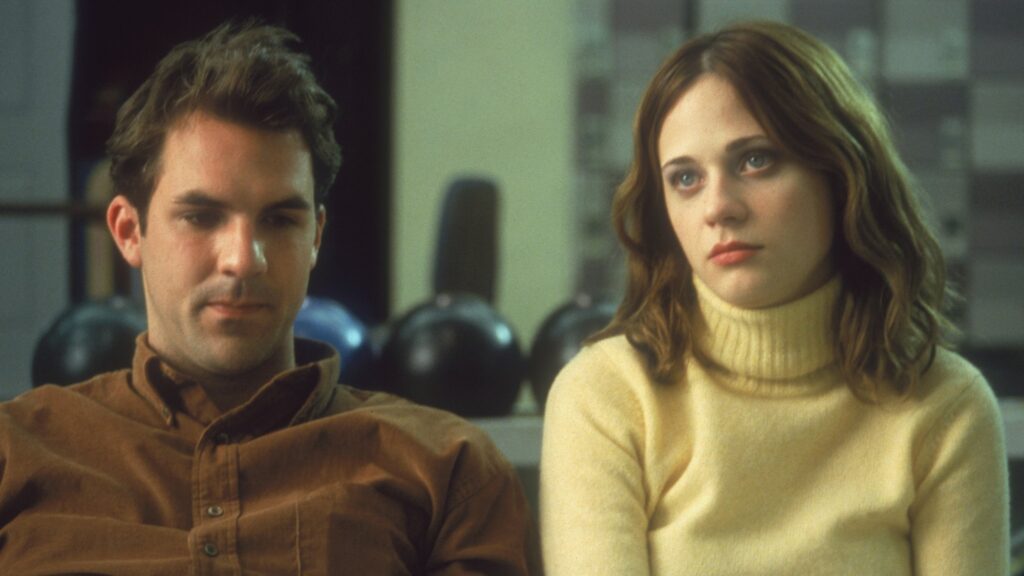
USA 2003 : David Gordon Green : 108mins
All the Real Girls is the story of two twentysomething American men fumbling awkwardly towards maturity. On-screen we have Paul (Paul Schneider), an easygoing 22-year-old mechanic, living with his mother Elvira (Patricia Clarkson) in small-town North Carolina and struggling to cope with his first serious adult romance. Off-screen there’s writer-director David Gordon Green, a 27-year-old making his sophomore movie after 2000’s acclaimed George Washington.
Paul hasn’t quite made the transition to responsibility: his relationship with his best friend’s sister Noel (Zooey Deschanel) is a tentative business, imperilled by both parties’ awareness of his long-standing reputation as the local hot-dogging Lothario. And Green himself has some way to develop: All the Real Girls hovers precariously on the edge of affectation and self-indulgence, not least in the script department. Was it, for instance, really necessary to make Elvira a professional clown?
And though the film’s end credits (and publicity materials) reveal our hero and heroine’s names, these crucial details are coyly withheld during the movie itself. Likewise, the title—All the Real Girls is never spoken or otherwise explained; we’re clearly supposed to take this as a mood-piece without specific meanings or straightforward answers. Direction-wise, Green is rather too fond of the heavy-handedly lyrical incidental music which he uses to bind together his short, fragmentary, naturalistic scenes of this rural small town (mostly filmed in Marshall, NC) and its inhabitants—the atmospheric cinematography is courtesy of Tim Orr.
Watching All The Real Girls, the viewer may suspect that endless footage was shot, with the performers given much latitude to improvise within the guidelines of their characters, before Green (and editors Zene Bakel and Steven Gonzales) sat down to organise them into a rough, slowburning narrative form—perhaps it’s no accident that the poster’s tagline reads “Love is a puzzle; these are the pieces.”
Luckily for all concerned, the actors—without exception—seem to get what Green is doing, and respond with convincing characterisations: the dialogue sounds fresh and believable, the action seeming to develop organically out of the personalities involved. As Noel’s brother Tip, Shea Whigham has the easygoing hipster charisma of a young Kevin Bacon, and turns in such a vivid turn he rivals “Queen of the Indies” Clarkson for supporting-cast honours.
But this is very much Paul’s story, and in many ways it’s Schneider’s film—he collaborated with Green on the story and script. Refreshingly, the actor isn’t quite conventional leading-man material—imagine a young, slighty overweight Scott Bakula—and he builds a compelling figure out of this superficially ordinary young bloke. By the time we get to the film’s ambiguous finale—and nicely upbeat coda—Paul has emerged as a genial and surprisingly touching figure, one very much worth spending a couple of hours with.
Green likewise does more than enough to indicate real talent: as a scriptwriter, he’s to be commended for avoiding melodrama—this is the rare young-romance movie that gets by without a third-act tragedy. If anything, however, Green tries a little too hard to avoid the usual histrionics of movie romances as a drama, and All the Real Girls feels a little under-powered.
As in real life, not a great deal actually happens: Paul and Noel’s relationship does come under severe test, but this is as much a result of communication problems as actual events themselves. The pair are way too articulate for their own good most of the time, then prove unable to verbalise their real feelings when a real crisis does arise. Just occasionally, Green gives the pair some truly awful lines including one desperately wacky bit of dialogue about the invention of peanut butter.
In terms of directing, however, Green is much closer to the finished article: there’s one sublime moment, when Paul joins Elvira at work and the pair improvise a clown-dance to an audience of hospitalised children, that achieves truly Altmanesque heights of inspired looseness, a blissful synchronicity of acting, camerawork and music. It isn’t a long sequence, but it’s enough to suggest Green is likely to take high rank among American directors as his career progresses. Next up is The Undertow, apparently followed by an attempt at John Kennedy Toole’s “unfilmable” novel A Confederacy of Dunces. Green, it seems, certainly won’t fail for lack of nerve.
Neil Young
22nd July, 2003
(comprehensive rewrite of original 16th February review)
seen 7th February, Cinemaxx Berlin, Berlin Film Festival (market) [also showing in Forum section.]
For all the reviews from the Berlin Film Festival click here.