


MOGADISHU BLUES: RIDLEY SCOTT’S BLACK HAWK DOWN [5/10]
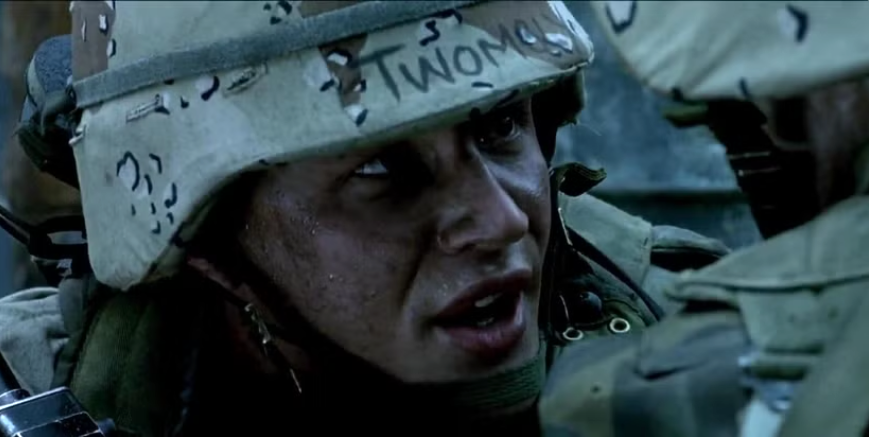
America’s botched Mogadishu operation* of 1993 is the backdrop to Black Hawk Down — for director Ridley Scott a return to the terrain of White Squall, the now-forgotten men-&-boys-ensemble sailing-picture flop that preceded his box-office double whammy of Gladiator and Hannibal. He’s now established as a versatile, jobbing director-for-hire, as comfortable in the dusty streets of Somalia as the shadowy recesses of Florentian galleries or the vast expanses of the Roman Empire. This time, he brings Mark Bowden’s bestseller to the screen with hands-off neutrality — whether the film is pro or anti war, pro or anti the US, pro or anti the Mogadishu op… all are left in the eye of the beholder.
It can be read any which way: either as gung-ho, Behind Enemy Lines style flagwaver — in which capacity it was screened by President Bush to 20 Republican Senators — or as a pacifist Thin Red Line tract, convincing us that War Is Hell by putting us through it for two solid hours. Scott, of course, started out in advertising — his most famous commercial being for the Hovis loaf. He still owns a large production house, and he’s never quite left that world behind — throughout Black Hawk Down, you feel like you’re being sold something… and whatever it is, you suspect it probably isn’t as good for you as brown bread.
Leaving aside the guiding ideology (or lack of) on show, however, its appropriate that the film’s pivotal event is the downing of a pair of Black Hawk helicopters. Because Scott also ends up defeated by the cumbersome vastness of his hardware as — like commanding officer Garrison (Sam Shepard) — he gradually loses control of his intricately planned exercise.
What should be a developing story bogs down into a succession of noisy scenes, and Scott seems so distracted planning his next bit of pyrotechnics that the actors end up left to their own devices. This results in some plain bad performances — Orlando Bloom is worst of the lot as a greenhorned grunt, though Ewan McGregor’s ropey “American” accent places him not far behind. In the nominal lead, Josh Hartnett growls out his lines in a grim monotone, allowing Eric Bana to steal the show as a seen-it-all, too-cool-for-school, mountain-bike-riding Action Man, somehow retaining his badass dignity (not to mention his straight face) as he spits out some of the script’s corniest frontline homilies.
Very few of the others make much impression — though its clearly part of the film’s point that we can’t tell them apart or make any emotional connection with them. Everything, of course, can be defended as part of the point: the dehumanisation, the chaos, the numbness, the tedium. And whatever criticisms you try to level at the film can probably be traced back to Bowden’s book, such as the unambiguously shameful way each of the 18 US fatalities are identified by name in the end titles, while at the same time were quoted the rough figure of 1,000 Somali dead.
Every time an American dies in Black Hawk Down, it’s an event — the “skinnies,” however, are mown down by the dozen. Yes, “skinnies” is how undernourished Somalians are referred to throughout the film — but, of course, that isn’t the film speaking. It’s the book. It’s the soldiers. So that makes it all right.
Neil Young
29th January, 2002
(seen 14/1/02, Warner Village, Newcastle)
* the actual name of this operation was, somewhat incredibly, Operation Gothic Serpent.
[NY 8/12/25]
–