


Cluj 2015: The second of two dispatches by Sheila Seacroft
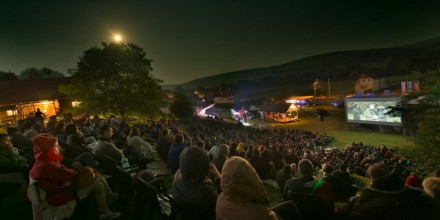
One of the admirable things about TIFF (Transilvania International Film Festival) is its audiences. Even the 10 am screenings are respectably full, of a crowd of varied age, and while students predominate, there’s plenty of evidence of townspeople dropping in in the course of their normal lives – women have their shopping bags, and there was even a man with a dog in the first ever TIFF film I saw 10 years ago.
For me, as well as the added value of seeing a Romanian film alongside Romanian people, there’s a fascination in watching a sub-titled English film in their company, and especially one in which subtle nuances of script are a vital part, like the competition film, Tom Browne’s Radiator. It was good to see the Clujeans were as taken by it as I was. There was an added poignancy to Richard Johnson’s terrific performance here, as between the screening of his film and the presentation of a lifetime achievement award at the closing ceremony, which he had originally planned to attend, he died. The connection is that as a young actor he was well-known in 60s Romania when he starred in Columna, a national epic of Roman times which remains one of the most viewed films in the country. Radiator is his swansong, and probably career-best, as Leonard, an angry bully, raging against the dying of the light in a ramshackle farmhouse in Cumbria. When he refuses to leave the sofa where he has parked himself, long-suffering wife Maria (Gemma Jones) rings their London-based son (Daniel Cerqueia – also co-screen-writer) for back-up. We see the house through his eyes on arrival, filthy, mouse-ridden and heaped with things. And it’s clear that this is not just the result of recent deterioration but of years of letting things go, by both of them.
The camera prowls round the dark, stacked rooms like an unseen guest, spotting hints of what a civilised life there might once have been here. It’s an uncomfortable watch, especially for those who are both ageing parents and children of the elderly themselves, and the occasions when it leaves the interior for the fresh air and views of Cumbria are like a liberation for the audience too. Cerqueia cleverly manages to make the son not entirely likeable, however much we may empathise, and our sympathy is drawn to Maria. Though bullied and with practically no personal freedom (though she does escape for a weekend with old college friends, when in velvet and pearls we see a glimpse of her as an independent woman), she remains polite with her husband and acts as if his behaviour is normal, not so much from being browbeaten but out of habit and, maybe, love. Like Joanna Hogg’s dry and devastating portrayals of a similar level of society, it catches perfectly the polite, subtle, self-deprecating tones of a middle class speech that conveys more by what it doesn’t say than its polite surface indicates, as the tangled trap of family, memory and obligation pains, exasperates and at times even amuses the viewer too. It’s an exciting debut feature.
The theme of old age seems to be something of a preoccupation this year. A short retrospective of Bent Hamer, who first came to international attention with the splendid Kitchen Stories in 2003, included Eggs, a tale in the same darkly comic vein from 1995. Two elderly brothers, Moe and Pa, (Sverre Hansen and Kjell Stormoen) live alone together in the countryside in a charming if rather dilapidated house, where even the stairs have their own eccentric character. Their daily routine is steadfastly unchanged, broken only by the arrival each week of the friendly, nubile cleaner and delivery men. Until one day a phone call informs them that Pa’s son Konrad (the wonderful Leif Andrée) must come and live with them as his mother has gone into hospital. It seems Pa had a motorbike trip to Lillehammer many years ago and Konrad was the result. His arrival –and what a surprise it is – disrupts the even tenure of their dull lives, turning quirky to very sinister and triggering change. Hamer’s sharp-edged but gentle economy of narrative and the way he invests objects with character is a pleasure to watch, there again in his most recent film 1001 Grams, about a young woman scientist responsible for the ‘national kilo’, the actual weight which sets the benchmark for all weights and measures in the country. Uptight, unhappy, she treats herself and her life as precisely and strictly as the weight she is in charge of, until a trip to a conference in France opens up her life. It’s on paper a simple, even hackneyed, tale but with Hamer’s left-field and dry take on human behaviour it’s charming.
Old age is there again in 2 documentaries, the more straightforward being Bondoc, a sensitive if rambling encounter with elderly chess grand master Dan Bondoc, on the occasion of his trip to a tournament in honour of his old friend. At home in his flat he’s just another sometimes confused old man getting mixed up with his tablets and worrying about where to buy pretzels, but at the tournament it becomes an even more painful portrait of ageing, as Bondoc recognises his fading powers, and is torn between pleasure that his age and reputation are honoured, and anger and puzzlement at his defeat at the hands of younger players. A crotchety Lear, he’s as angry at himself and his decline as at the upstarts who have beaten him, and the film-makers, themselves young, wisely leave it to us to observe and think what we will about this very bad loser who is also endearingly honest, making it a ragged and sympathetic portrait of a complex man in decline.
A far more positive take on ageing, in fact the film in which I laughed most in all the festival was Stream of Love (Szerelempataka) a delightful documentary by Hungarian director Ágnes Sós, in which elderly individuals in an ethnic Hungarian village in Romania reminisce and joke about their emotional and sexual lives. Ágnes Sós has coaxed tremendous interviews out of them. They are amazingly, almost shockingly frank – comical, regretful, but mostly merry. While the story of unrequited love of a husband for his philandering wife strikes a tender mournful note, and the confessions of an unlikely murderer provide a moment of shock, most of these healthy-looking, hard-working, suntanned folk in the country setting from which they seem almost to emanate like good-natured spirits of place, tell of robust relationships and much happiness, and one of the strongest images of the festival comes when three game old girls out for a picnic up the hill in their big old-ladies’ skirts and pinnies recreate the time when they, clasped by the boys they fancied, rolled at speed down the length of the hay meadows.
Georgian director George Ovashvili’s Corn Island (Simindis kundzuli) also sets an ageing protagonist against the natural world and the seasons. Every spring where the Enguri River meets the Black Sea, there appear small islands of fertile silt washed down by the winter rains. Abga (Ilyas Salman) brings his granddaughter there to help grow maize for a season. As they sow seed and build a cabin of wood and thatch, we observe an idyllic scene, but one that is sometimes broken by patrolling army boats as the spot lies on the border of Georgia and the breakaway state of Abkhazia. Slow cinema at its best, a near documentary style reminiscent of early Georgian film of the Soviet era it translates ordinary physical human activity into a kind of poetry, with the feeling of life and nature moving inexorably on, as the girl matures, the old man wearies, political issues impinge, and nature shows it can be as harsh as it can be bountiful. But seasons, and disputes, will always come and go, leaving always a small trace of what once was.

Two Romanian documentaries which must have had personal resonances to many of their audience were shown back-to-back in the rather odd ‘Military Centre’, an old theatre space used in the past for training and no doubt ‘military-friendly’ cultural events. Still redolent of a more dubious past it sits in chilly grandeur above the Victoria Cinema where it has been commandeered by the festival these last 2 years. Aliyah Dada is Oana Giurgiu’s highly original account of Romanian Jews, a whirlwind history based on new and archival interviews and old photographs, which she vividly brings to life by a brisk system of collage, creating almost the look of film, a Dadaist technique that pays homage to two of the pioneers of that movement who were Romanian Jews. Romanians were among the first Jews to embrace the kibbutz idea and began to move over 100 years ago to Palestine, where, mostly unused to agriculture, they learned the ways of the land from local Arabs. In the early days near catastrophe and famine ensued, while back in their homeland the fluctuating fortunes of the Jews over the twentieth century, with eyewitness accounts and dreadful photographs, make shocking viewing. Postwar communism, though at first welcomed by many, brought another round of imprisonments and persecution. It’s a huge story and almost too much to take in, but the inventive method of telling, along with some charming and articulate interviewees, leads one breathlessly down the years. It ends with the virtual ‘selling’ of Jews to Israel by Ceauşescu through a hugger-mugger arrangement with Golda Meir, earning millions, much of which allegedly went into the Ceauşescus’ private accounts.
Next along came Razvan Georgiescu’s Trading Germans (Paşaport de Germania), unearthing, in more traditional fashion, another bright idea of Ceausescu’s to make money out of his people, where an arrangement with Germany in the 70s and 80s found ethnic Germans from Romania being allowed to leave for Germany in return for payment of huge sums by the German government. The clever bit was that the state also pocketed fees itself from the would-be emigrés to speed their departures. Various dubious middlemen seem also to have cut themselves a slice. Not exactly hugger-mugger this time, but kept very quiet by both governments, meaning that it remains a mostly untold story. Eminent folk testify to what went on, including Foreign Minister at the time Hans-Dietrich Genscher. The Germans were descendants of settlers who came in two swathes – the ‘Saxons’ in the twelfth and ‘Swabians’ in the eighteenth centuries, forming a considerable population, who while keeping a degree of their Germanic culture and language were in most respects Romanian. These people, and the German government, were fleeced to the tune of millions, many in considerable debt to friends and family for years afterwards, having borrowed the extra money. Their testimonies are emotional, and though most seem to have settled well and prosperously into their re-found homeland, they still feel the ties to their old lives and surroundings. Very few ethnic Germans remain, but what were often sad decisions for people whose background felt nothing but Romanian, it’s probable they were the envy of many ethnic Romanians longing to escape to new lives.
A last word on the Romanian Shorts this year. Always an exciting section, this year’s 18 entries more than doubled previous offerings. Comedy was a strong point, with Art, Adrian Sitaru’s wry look into the world of film-makers and the sometimes spurious justifications of art, and Gabriel Achim’s little comic vignette of a downtrodden husband (Gabriel Sphiu) who loses his wedding ring and then gets more than he bargains for, Verigheta (The Wedding Ring). Tudor Botezatu’s fast moving The Big Boys (Profesionişti) is a hilarious and snazzy meld of verité-type filming and clever script, while the very odd The Cork Justifies the Means (Dopul scuza mijloachele) is a wonderfully choreographed and designed piece of absurdity somewhat let down by a weak story. Spookiness comes in the form of Lag, a novel three minute exercise in mounting suspense by Bogdan Orcula and Anton Groves. Ana-Maria Comanescu’s 16mm-shot In the House captures the freneticism of a party where a shocking truth begins to impinge. Inner turmoil loomed large, from Ioana Flora’s anxiety-ridden Dana in Marius Olteanu’s Tie (Scor alb) to Mihnea (Angel Damian)’s misery at failing to find a girlfriend in Vera and the two boys staying with their grandparents in the country whose escapades come up against an unpleasant reality in Summerbreak (Vacanţa la ţara). But it’s probably the notion of violence that stays with you overall, and the proximity of death, as presented in two very different ways in the joint winners of the Award this year.
Andrei Creţulescu’s Ramona is the third film in a loose trilogy that has lit up the Shorts section for the past two years, often using a dry and black comedy and crackling dialogue. But this one is a wordless, deadly serious account of vengeance which says so much in so little, as an unknown woman wreaks icy havoc on those who have hurt someone she loves. Spare, perfectly paced, unnerving, there’s not an inch of fat on its 24 minutes of shocking action. Sharing the award was Roxana Stroe’s Black Friday, where the inoffensive-looking Mihai (Gabriel Sphiu as an ordinary joe again) finds a novel way to get to the front of the food queues in Communist Romania. With his little pack of sugar cubes for sustenance and his big gun and his cool logic he becomes a sniper in his local estate. Simultaneously horrifying, moving, funny and beautiful (the bodies fall as seen from above – sniper’s and God’s eye-view – in a kind of dance of slow motion) it says complicated things in typical dry and bitter Romanian fashion about the society in which it’s set. Two winning films as different as can be stylistically and genre-wise, but both lingering in the mind for long after. As did the Special Mention Pavel by Aexandru Ranta, a perfect and affecting study of the loneliness of old age.
Sheila Seacroft
4th July, 2015
PART ONE