


RIO – BRAVO? : Justin Lin’s “FAST FIVE” [6/10]
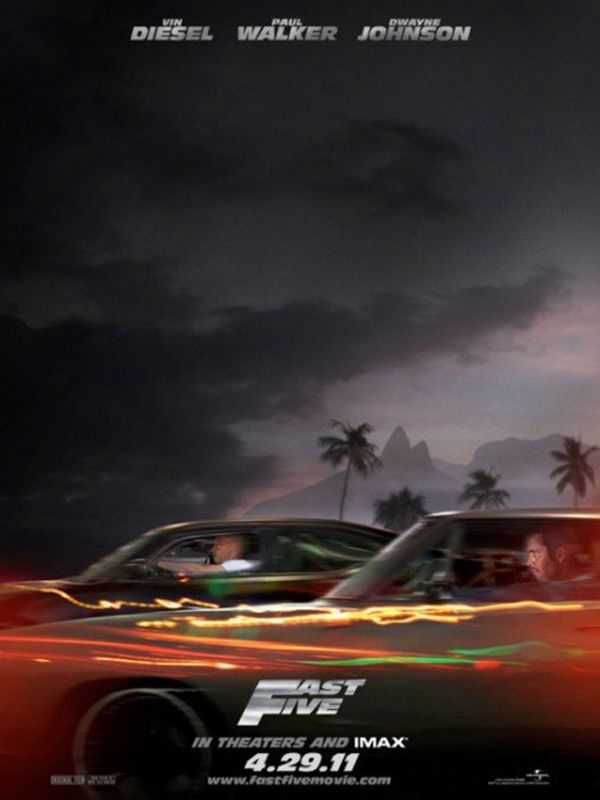
Familiarity breeds contentment – sort of – in the case of Fast Five, latest addition to an improbably long-lived and lucrative franchise-by-accident which kicked off a full decade ago with Rob Cohen’s The Fast and the Furious. What started out as a fanciful delve into the illicit street-racing scene of Los Angeles has gradually morphed into a heist-centric series of pictures – rather closer in theme to Dominic Sena’s ropey Gone In 60 Seconds (2000) and dopey Swordfish (2001) than to Cohen’s original, which concerned the efforts of undercover cop Brian O’Conner (Paul Walker) to infiltrate the street-racing subculture by befriending the tough-guy star of the circuit, Dom Toretto (Vin Diesel).
A decade later, O’Conner and Toretto are now both on the wrong side of the law – the former having left the FBI at the end of the fourth movie in the series, Fast & Furious (2009) to globetrot with his girlfriend, Dom’s sister Mia (Jordana Brewster). O’Conner and Toretto meet up in Brazil, where Toretto’s old partner-in-crime Vince (Matt Schulze) is planning an audacious theft of several valuable cars from a train. Complications ensue when it turns out that the heist has been ordered by Rio de Janeiro’s crime kingpin Reyes (Joaquim de Almeida) – whose enormous wealth is targeted by Dom and Brian as the passport to an early retirement.
Getting their hands on Reyes’ well-protected assets is a dauntingly tricky task, calling for the assembly of a gang comprising various supporting characters from earlier movies in the franchise, the most welcome being the loquacious and strutting Roman Pearce – last seen in 2 Fast 2 Furious (2003) and played once again by Tyrese Gibson. Indeed, I concluded my review of Fast & Furious by stating that any fifth episode in the saga would be “entirely missable unless … calls are placed to … Messrs Gibson and [Lucas] Black,” the latter having starred in what remains the most noteworthy of the quintet – and also the least lucrative at the box-office – 2006’s The Fast and the Furious: Tokyo Drift.
Bringing Gibson’s Pearce back was, for returning scriptwriter Chris Morgan, a straightforward matter. Black’s Sean Boswell, however, is a different matter entirely – because, in an odd quirk of story-development, Tokyo Drift actually takes place chronologically after the other four parts of the series. The character which links parts 3, 4 and 5 – Sung Kang’s laconic, unflappable Han – is killed near the end of the third movie, Tokyo Drift, but is alive and well in the most recent two entries. So whatever shenanigans he gets up to in Fast Five, we know he’s going to be around for the end credits; likewise Diesel’s Toretto, who pops up right at the end of Tokyo Drift for a cameo.
Of course, Diesel has become such a key figure in the Fast/Furious universe that his demise here was always likely to be an extreme longshot; likewise his four-time co-star Walker. The latter, having been the decidedly weak link in the first two pictures – a white-bread putz glaringly out of place among an exotic, ethnically diverse galaxy of glowering badasses (male and female) – has in parts four and five finally grown into his role and here essays a reasonably convincing presentation of a street-toughened (if essentially decent and sympathetic) action-guy, although his “tender” scenes with (a worryingly skin-and-bones) Brewster as Mia have a perfunctory, going-through-the-motions feel.
Indeed, spectacular (and laws-of-physics-disregarding) set-pieces apart, there’s not much in terms of plot to make Fast Five stand out from the general run of mainstream slam-bang thrillers, the picture remaining watchable because of (a) its adventurous exploration of photogenic Rio locales (including numerous vertiginous aerial swoops over the city’s landmark Christ statue – close enough to make out His teeny-tiny crown); (b) Lin’s preference for old-school stunt-work instead of the now-standard dominance of CGI, and (c) the easygoing chemistry between the crowded ensemble, who seem genuinely pleased to be all back together working on the same movie, with a director who – on his third Fast/Furious outing – exerts a confident control over proceedings.
That said, the picture is far too long at 130 minutes, and even at this bloated length two elements are conspicuously lacking: de Almeida’s Reyes is a decidedly two-dimensional villain, while Dwayne Johnson’s garganutan, uber-bad-ass fed switches too quickly (and too predictably) from being Dom and Brian’s blunderbuss of a nemesis to their doughty ally.
Then there’s the absence of Black’s Boswell, who happened to be the most fully-realised, charismatic character in the series, and was played by arguably its most talented actor – making it more than a pity that he’s the sole principal who doesn’t get to join the party this time around. At the end of the picture Han makes an in-joke comment that he’ll get to Tokyo “eventually” – and if the Fast/Furious money-machine is ever going to yield a truly worthwhile diversion, one that might even appeal to a demographic beyond its young-male target audience, it’s to be hoped that Lin, Morgan and company put their collective pedals to the metal and get us back to the Japanese capital sooner rather than later.
Neil Young
19th May, 2011
FAST FIVE : [6/10] : USA 2011 : Justin LIN : 130 minutes (BBFC) : seen 16th May at Empire cinema, Sunderland (£6.50) : {17/28}