for Tribune: George Clooney’s THE IDES OF MARCH [4/10]
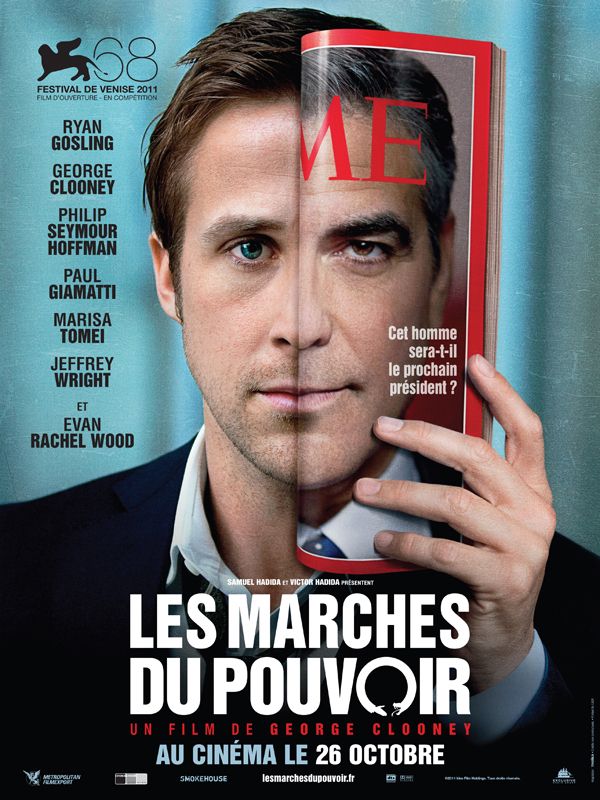
The Ides of March
Director: George Clooney
Caesar: Who is it in the press that calls on me?
I hear a tongue shriller than all the music
Cry “Caesar!” Speak, Caesar is turn’d to hear.
Soothsayer: Beware the ides of March
[William Shakespeare: Julius Caesar Act 1, scene 2.]
… And it turns out that deceased Roman Emperors aren’t the only ones who should beware The Ides of March. 21st-century cinemagoers seeking sophisticated, politically-flavoured, awards-worthy entertainments are advised to stay at home with their West Wing and Thick of It box-sets rather than shell out to see the fruits of George Clooney’s fourth stint in the director’s chair.
Because whereas Clooney’s behind-the-camera debut Confessions of a Dangerous Mind (2002) showed a certain wayward promise, more than fulfilled by his outstanding followup Good Night and Good Luck (2005), his American-football comedy Leatherheads (2008) was genially unremarkable fluff – and now this adaptation of Beau Willimon’s 2008 play Farragut North sees the uncrowned ‘King of Hollywood’ biting off much more than he can chew and coming quite the cropper as a result.
If nothing else, The Ides of March in some ways confirms Clooney as the Warren Beatty of his generation: a left-leaning Democrat who might occasionally talk – in airily uncommitted fashion – of standing for elected office, but who prefers to channel his energies into “worthy” big-screen projects. Not that Ides could ever be mistaken for Beatty’s magnificent historical epic Reds (1981) – the focus here is firmly domestic, following a Democratic primary in Ohio involving two viable candidates who could be propelled towards the White House (because, as someone remarks within the first few minutes, “as goes Ohio, so goes the nation.”)
One of the duo is Governor Mike Morris (Clooney), an idealistic but pragmatic chap who in the US would be classed as some way over to the Left (“I’m not a Christian, I’m not an Atheist” as he remarks in his opening speech.) But, this being a Hollywood movie, Morris’s opponent is even further to the Left – “a pro-choice tax-and-spend liberal” no less. The Republicans, we’re told, reckon Morris’s rival would be an easier foe to vanquish – and, Ohio being an ‘open’ primary in which both Republicans and Democrats can participate, Morris faces no easy path to victory.
The film’s main emphasis is on the ploys and chicanery employed within his campaign – The Ides of March is for those who (correctly) reckon Hunter S Thompson’s finest hour wasn’t Hell’s Angels or Fear and Loathing In Las Vegas but Fear and Loathing on the Campaign Trail ’72, his fly-on-the-wall report on the slow-motion car-crash that was George McGovern’s challenge to Richard Nixon. Morris’s chief campaign strategist is wily, obsessive Paul Zara (Philip Seymour Hoffman), whose opposite number is the similarly battle-hardened Tom Duffy (Paul Giamatti).
A key pawn in the game – or perhaps he’s a slightly tarnished knight – is Zara’s number two, idealistic young Stephen Myers (Ryan Gosling), whose loyalties come under strain as he realises Morris isn’t the plaster saint he’d long imagined. Morris’s feet of clay are revealed thanks to his involvement with 20-year-old intern Molly (Evan Rachel Wood), with whom Stephen is also conducting a semi-illlicit dalliance. Stephen is no Candide, but his loss of innocence provides The Ides of March with its main narrative thrust – one fatally hampered by the melodramatic shenanigans which develop after Molly becomes pregnant – Morris being the Clintonesque culprit.
Considerable stretches in The Ides of March ring true, and it’s no surprise to learn that Willimon based his play on his experiences with the highly entertaining but explosively abortive Howard Dean campaign of 2004 – the screenplay, credited to Clooney, Willimon and Clooney’s longtime collaborator Grant Heslov (he of the woeful Clooney vehicle The Men Who Stare At Goats), also incorporates several elements of Barack Obama’s rather more adroit stealth-assault on the White House three years ago.
And there’s a certain amount of pleasure to be obtained from seeing such seasoned pros as Giamatti, Hoffman and Marisa Tomei – as muckraking journalist Ida – at work. But this only gets us so far – and while Tomei’s role is insultingly underwritten, she arguably comes off better than Wood (whose Molly is little more than an amalgamation of plot-contrivances), and at least has something to play, unlike poor Jennifer Ehle who gets about two lines as Morris’s long-suffering spouse.
This is very much a Boys’ Own version of American politics, a sub-David Mamet affair that’s flippantly cynical in its forensic dissection of the routine cruelties and hypocrisies which play such a pivotal part in all major campaigns – but which relies for its effects on hopelessly implausible and heavy-handed script-developments in its final third which more than undo whatever good work has gone before. After Drive, Gosling provides further evidence that he almost certainly isn’t Hollywood’s current leading-man-in-waiting, while Clooney, for the first time in his career, provides clinching evidence that he really should just stick to the (astronomically lucrative) day-job in future.
Neil Young
18th October, 2011
(written for the 26th October edition of Tribune magazine)