
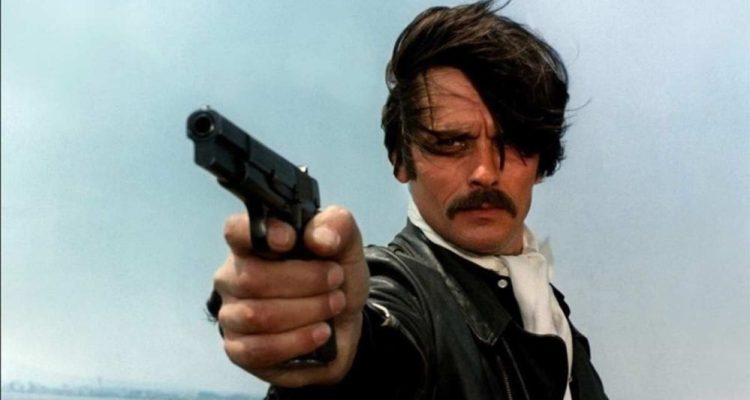

July 2010 ¦¦ -3- ¦¦ ‘Bed and Breakfast’ (1930) [7/10] and ‘The Dog Who Loved Trains’ (1977) [8/10]

. Bed and Breakfast .
Eighty years on, Bed and Breakfast remains a breezily enjoyable and unexpectedly saucy farce, made by prolific actor-turned-director Walter Forde (Britain’s answer to Harold Lloyd) in the gap between the coming of sound – opening titles specify that it was made under the British Acoustic System – and the crackdown on perceived cinematic licentiousness best exemplified by Hollywood’s 1934 ‘Hays Code.’
‘Frankness’ is evident from the very first scene, with casual references to a Bohemian character belonging to “the new Sex Expressionism school of art”, and to “orgies” in Paris. Infidelity concerns drive the narrative, as a pair of upper-class London couples with too much time and money on their hands become embroiled in jealousy-stoking ploys and subterfuges.
The convoluted plots and sub-plots converge on ‘Mon Repos’, the barn-like studio-cum-cottage near the village of Sexton Shoebury (“a nice run… on the road to Bath”). This is where, one long notably rain-sodden night, various British archetypes from various social strata – including a bookie, a cleric, and a pair of burglars (“these country places are easy cribs to crack”) – find themselves under the same roof. Think James Whale’s The Old Dark House (1932), played purely for unpretentious belly-laughs.
The script was only the second feature credit for Sidney Gilliat, who went on to adapt The Lady Vanishes and Jamaica Inn for Hitchcock, and achieved notable success in collaboration with partner Frank Launder. This one is based on a play by Frederick Whitney which probably wasn’t anything out of the ordinary on the West End stage, but which serves as an invaluable record of a certain bygone theatrical form. ‘Opened out’ by director Forde with a bit of imaginative camera-movement here and there and even a couple of outdoor scenes, Bed and Breakfast contrives to pack a surprising number of amusing situations and lines into its brisk running-time of just over an hour.
Indeed, in sheer terms of laughs-per-minute, the picture must be reckoned a resounding success. Moments of wild slapstick hit the target, even if most of the performances seem pretty dated to modern eyes (the actors carefully enunciating their lines for the benefit of the new-fangled microphones.) The most notable exception is young Ian Wilson* – expertly underplaying as the bookie’s timid teenage son Theodore – who steals several scenes with his facial reactions and a tiny handful of lines.
Elsewhere, the tone is a combination of broad humour and ribald wit: “My husband is a pillar of the church!” declaims Muriel Aked’s prim-and-proper Augusta Boas, outraged wife of pompously verbose Canon Boas (Frederick Volpe) as the clergyman is arrested during the suitably raucous climax. PC Plod’s response: “He’ll soon be a column in the News of the World.”
[24/7/10]
. The Dog Who Loved Trains .
Anyone wanting a flavour of late-seventies Yugoslavia – and/or a well-constructed, character-based picaresque drama with romantic and tragic elements – could do much worse than seek out The Dog Who Loved Trains, an engrossing and rewarding example of mainstream commercial cinema from the final years of the Tito era.
Because the three main characters are almost perpetually on the move – on foot, on horseback, on trains, in cars and trucks, on boats, even a motorbike-with-sidecar combo at one stage – for various reasons, we see many different areas of the country from tiny rural villages to the frenetic capital Belgrade, and pretty much everything in between.
This is the atmospheric backdrop for the haphazard, intersecting itineraries of three mismatched protagonists, none of them exactly ‘model’ socialist citizens. Escaped prisoner Mika (Svetlana Bojkovic) is an independent, thirtyish woman fleeing both the authorities and her smuggling past; larger-than-life Rodolyub Rodney (Yugoslav mega-icon Velimir ‘Bata’ Zivojinovic) is a charismatic former movie stuntman in his forties (supposedly a double for “Stewart Granger, Lex Barker and Kirk Douglas”) now on the road with his rodeo show; Mladic (Irfan Mensur) – is the meek-and-mild, twentyish son of a railroad man, on a quest to find ‘Ding’, the errant, loco-hopping family pet that provides the picture’s cutesy title.
But don’t be put off by that twee-sounding moniker (or by the early stretches’ slight aimlessness). The script by Gordan Mihic – who later collaborated with Emir Kusturica on Time of the Gypsies and Black Cat, White Cat, and more recently co-wrote Sergey Stanojkovski’s similarly well-observed Contact (2005) – deals deftly with full-blooded material which could easily have been played for melodrama and cheap sentimentality, but which here is handled with tact and restraint.
The most vivid example of this comes when Mika is raped in the well of a grimy city-centre repair-garage one dark evening. Taking place off-camera, proceedings are observed from above, through an attic window, by a passing dog (not the elusive Ding); afterwards, the traumatised Mika walks past a ballet-school where teacher and dancers obliviously go about their graceful business – only feet from the site of her gruelling ordeal.
Director Paskaljevic successfully strikes a tricky balance between such grittiness and the more generally prevailing tone of low-key, unassuming charm – as in a marvellous scene at a damp, deserted fairground when Rodney’s grey horse (played by the remarkably well-trained ‘Raketa’, or ‘Rocket’) passes repeatedly backwards and forwards in front of Aleksandar Petkovic’s camera while the picture’s human stars converse in the middle-ground. Mladic’s four-legged friend, meanwhile, makes just the one, fleeting appearance right at the end – part of a terrific climax that may catch you unwares with its abruptness and poignant intensity.
Neil Young
25th July 2010
: BED AND BREAKFAST : [7/10] : UK 1930 : Walter FORDE : 79m (BBFC) : BFI South Bank, London, 16th July (£9) : {19/28}
: THE DOG WHO LOVED TRAINS : [8/10] : Pas koji e voleo vozove : Yugoslavia 1977 : Goran PASKALJEVIC : 91m (BFI) : BFI South Bank, London, 17th July (£9 – with thanks to K.Corless & M.Diestro-Dopido) : {21/28}
* The career of pint-sized Ian Wilson (1901-1987) deserves an essay – perhaps a book – of its own. He’s a British counterpart of those invaluable, tireless, seldom-acknowledged bit-players so lovingly chronicled on that brilliant Hollywood-centric website, The Unsung Joe.
Among well over 160 movies listed on IMDb – in addition to dozens of TV appearances – the five-footer’s credits include major features such as Hell Drivers (1957), I’m All Right, Jack (1959), Suddenly Last Summer (1959), The Day of the Triffids (1962), Help! (1965) and his final picture, The Wicker Man (1973), in which he plays a ‘Communicant’ – in addition to no fewer than six Carry On pictures (Cleo, Cruising, Cabby, Constable, Jack and Regardless).
Wilson’s biggest exposure was probably as the “mysterious dwarf” sidekick of Herbert Lom’s Phantom of the Opera (1962). Elsewhere he was more often than not ‘uncredited’, including appearances listed as Boy Delivering Fish, Man On Stairs, Man In Fog, Man In Cinema, Man In Queue, Man Exiting Stage Door, Man In Phone Box, Man On Stairwell, Man Eating Sandwich, Man At Demonstration, Man Listening To The Speech, and, perhaps most tantalisingly, Man In Leopard Skin (Out of the Blue, 1931) and Bespectacled Man In Palace Kitchen (Love in Exile, 1936).