


SPREE CITY: Michael Pattison Reports, and Escapes, from the 2014 Berlinale
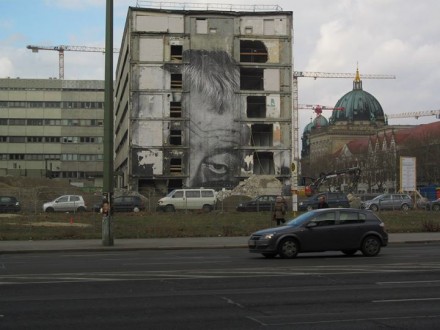
It is not what they built. It is what they knocked down.
It is not the houses. It is the spaces in between the houses.
James Fenton, A German Requiem
— — — — — — — — — — — — — — — — — — — —
There are many ways to feel—and be—consumed by a film festival. By its hustle and bustle; its fatiguing schedule; its late nights and early starts; and the first-world problem of having to balance three to five films a day, and write about them, and then meet up with colleagues and contacts, to drink and network. By the unpredictable weather, the variable people, the inflated prices and the pointlessly convoluted rules by which accredited press grow vexed—and to which staff and security abide with quiet, smiling passion. By the palpable arrogance and visible rudeness of industry delegates for whom local customs are just one more inconvenience to juggernaut with grumpy abandon. By the darkness, the lack of food, the receptions and cocktail parties that seduce you then abandon you at half-five in the morning.
All of those are part of the fun. What isn’t part of the fun is the sheer amount of mediocre films currently being made in the world and how many of them paying audiences are expected to sit through. At an event like the Berlinale, where one is unlikely to see a public screening that isn’t packed to capacity, there’s an alarmingly unquestioning blitz mentality at work, whereby locals and visitors alike seemingly turn up to the box office each morning to grab tickets to whichever films haven’t sold out for that day—something that doesn’t stop others from queuing at length for last-minute let-ins in the hour or so prior to a film’s start

Showing up on the evening of 11 February five minutes before the start of Claudia Richarz and Ulrike Zimmermann’s insightful documentary Vulva 3.0 in Potsdamer Platz’s CineStar theatre, this hot and bothered ‘member of the press’ was aghast to find the place nearly full. Asking if this seat was taken and if that seat was taken (queries which yielded only blank stares), I ended up two rows from the front of a giant auditorium, preparing myself for anatomical close-ups of vaginal openings and vulvic confessionals.
I came better prepared, however than the two middle-aged couples I sat beside, who exchanged perturbed looks and baffled whispers at the sight of the film’s first fleshy clitoris. Two minutes later they were up and gone, and in response to the four free seats to my left for the rest of the film all I could think was, “Didn’t these people know what the film was about? The clue’s in the title!”
Tuesday, February 11th was a kind day. I had begun it with The Kidnapping of Michel Houellebecq, Guillaume Nicloux’s comic rendering of the eponymous writer’s disappearance in 2011 while on a promotional tour for his then-new novel The Map and the Territory. An unassuming hoot with the real-life, nonplussed Houellebecq at its centre, the film provided renewed energy to what had become, barring Tsai Ming-Liang’s latest masterpiece Journey to the West two days previously, a rather tedious procession through offensively forgettable mush.

“Perhaps I’ve been seeing the wrong films,” I thought as I chuckled throughout Nicloux’s strangely intimate, ostensibly throwaway portrait of a self-promoting artist and the three hench-fellas who take him prisoner. By that point, though, it appeared to be too late. Having sat through too many curiously painful entries into what has seemingly been legitimised as a genre called ‘the festival film’, I had on the evening prior to seeing Michel Houellebecq resolved to up my hit-rate and set a day aside for retrospective screenings—which in Berlin demands an early enough rise to beat the lengthily eager delegate queues and secure tickets. February 12th promised better fare, then: up to six 35mm screenings, including a silent Ozu and some film called Citizen Kane by a man named Welles.
But back to the 11th. Too upset to be astonished at the patchiness pervading the 64th Berlin International Film Festival, I had also begun to wonder if my energy and enthusiasm were being consumed by something beyond the films themselves—by the very environs in which the Berlinale’s hub of activity unfolds.
With its glass façades, fascistic geometry and flashy aspirations to modernity (with which it’s not convincing anyone), Berlin’s Potsdamer Platz houses most of the festival’s venues, including all screenings for press and industry delegates. With red carpets at one end, abhorrent L’Oréal billboards at the other and a fistful of security personnel to stop folks from entering certain zones and from hanging around for too long to say hello to George Clooney, Potsdamer Platz is a pungently inexpressive place whose criminally-priced food stalls and coffee-shops ought to be enough to send anyone running.
So I went for a walk.

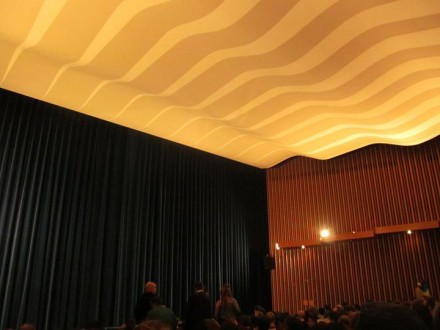
With my only duty in between Houellebecq and Vulva being to see Michel Gondry’s Is The Man Who Is Tall Happy?, I opted to travel to the latter’s screening venue—the Kino International—on foot. This cinema is located on Karl Marx-Allee, a boulevard built by the GDR between 1952 and 1965. Built between 1961 and 1963, the Kino International seats almost 600 people in its single, inclined auditorium. Padded walls and a wavy ceiling are specially designed for optimal acoustic reflection. It’s a beautiful building in its own right, though in the process of walking there, away from Potsdamer Platz and the temporary heart of film-industry kerfuffle, just about anything might have presented itself as a breath of fresh air.
Head east from Potsdamer Platz along Leipziger Straße. Leipziger Straße stretches today from Leipziger Platz in the west—which is located just east of Potsdamer Platz—to Spittelmarkt in the east. The octagonal square known as Leipziger Platz was destroyed in the Second World War, and has, since reunification, been restored with modern architecture. Spittelmarkt, a U-Bahn station that opened in 1908, takes its name from the square upon which St. Gertrude’s Hospital—founded in 1400—once stood.
Heading east toward Spittelmarkt, one can see a prefabricated apartment building, on top of which sits a giant Coca-Cola sign, whose red neon incongruously enlivens the building’s concrete exterior at night. (Across the road from this building is located the Cosmo Hotel. On the hotel’s TripAdvisor page, one customer has advised, “Ask for a room away from the main road, otherwise you will be treated to the flashing Coca Cola sign…”)

Where Leipziger Straße ends at Spittelmarkt, the road begins to curve northeast into Gertraudenstraße, and extends firstly across the Spreekanal and then the Spree River itself. The northern part of the island between the Spreekanal and the Spree River is known as Museumsinsel, or Museum Island. Museum Island is located in the northern part of an island that was the site of Cölln, the old sister town of Altberlin (Old Berlin). The earliest recorded mention of Cölln is 1237; Altberlin was first mentioned seven years later. The two towns, later cities, were separated only by the Spree, and were merged by King Frederick I in 1710 to form the capital of Prussia. They were merged under the new name of Berlin.
The bridge that crosses the Spreekanal is the Gertraudenbrücke. The bridge that crosses the Spree River is the Mühlendammbrücke (Mill Dam Bridge). Though the current bridge was built as recently as 1968, Mühlendamm dates back to the 12th century and to the formation of Cölln and Altberlin, at which point it was a ford on the trading route between Teltow and Barnim. Indeed, the otherwise innocuous features of the Mühlendammbrücke today belie its complex history at the centre of what we now know as Berlin.

Mühlendammbrücke leads east of the Spree onto Grunerstraße. Grunerstraße is named after Karl Justus Gruner, Berlin’s first chief of police. In quick succession along Grunerstraße, one can see St, Nicholas’ Church, Red City Hall and St. Mary’s Church. Further in the distance, viewable from the same vicinity, are Berlin Cathedral and the Fernsehturm—the Berlin TV Tower, an instantly recognisable silvery, sphere-spiking spire located on Alexanderplatz to the north.

St. Nicholas’ Church dates back to the 1220s, when it was built as a Catholic place of worship. It later became Lutheran, following the Protestant Reformation in 1539, and was deconsecrated on 31 October 1938. St. Mary’s Church, meanwhile, finds its earliest mention in 1292. Like St. Nicholas’ Church, it too was founded as a Roman Catholic church and later turned Lutheran Protestant in 1539. It is still in use today.
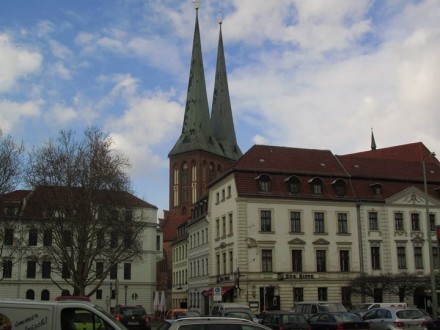
The Red City Hall is Berlin’s town hall. Designed by Gdánsk-born Hermann Friedrich Waesemann, it was built between 1861 and 1869. Following heavy damage in World War II, the building was restored according to its original plans between 1951 and 1956, at which point it was the town hall of East Berlin. Spanning a whole block, the building’s erection replaced several buildings dating back to the Middle Ages. After reunification, it assumed its current function on 1 October 1991.

Further along Grunerstraße, not far from such buildings, one comes to Karl-Marx-Allee. The boulevard, which was planned as “Berlin’s first socialist street”, was originally named Große Frankfurter Straße, which led east onto Frankfurter Allee. 2km in length, the road was renamed Stalinallee on 21 December 1949 to mark Stalin’s 70th birthday. When it was renamed Karl-Marx-Allee in 1961, following years of de-Stalinisation, its eastern section was reverted back to Frankfurter Allee.
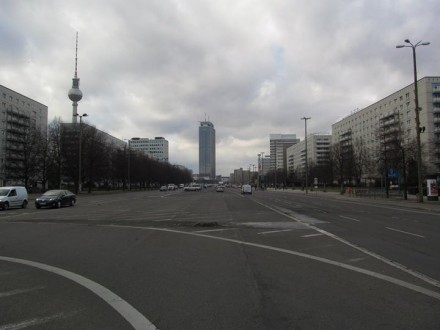
There seems, I think, to be a palpable drop in numbers in these parts of Berlin, people-wise. Regarding Karl-Marx-Allee this is especially contradictory, considering the large amount of houses that line either side of the 89m-wide boulevard. The entirety of Karl-Marx-Allee—down to its streetlights—is listed. The sudden expanse, the open skies, the grand uniformity of the architecture… This is a brighter Berlin, a more enduring Berlin. It is architecturally monotonous in the most romantic sense of the word. In Brian Ladd’s The Ghosts of Berlin: Confronting German History in the Urban Landscape (1998, p187), the Italian architect and designer Aldo Rossi is quoted referring to Karl-Marx-Allee as “Europe’s last great street.”
Karl-Marx-Allee was constructed in two phases. The first phase was between 1952 and 1961, and the second between 1959 and 1965. It was during the second phase, in which construction extended westward from Strausberger Platz to Alexanderplatz, that the Kino International was built. The cinema was designed by architects Josef Kaiser (1910-1991) and Heinz Aust (b. 1927). Reflecting the forward-facing design of an auditorium, the front of the building’s exterior faces the road with a glass façade; its sides and back are concrete.
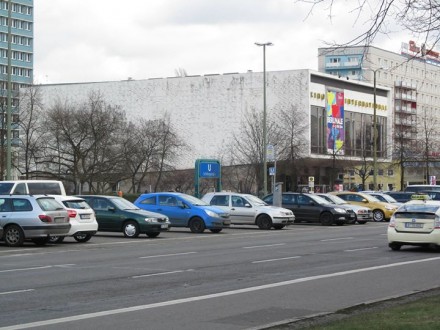
The Kino International was the primary cinema for premieres in the GDR. In this apparently most “socialist” of theatres, of course, preferential treatment was a given: true to the class-based nature of theatre seating, there are eight rows in the Kino with extra legroom, which would have presumably been reserved for the top brass, and for visiting dignitaries. In addition to the reserved area known as the Representation Room—now known as the Honecker Lounge, named after Erich Honecker, leader of the GDR between 1971 and 1989—there was also a basement, which hosted members of the state leadership before and after galas.
Fittingly, the last film to have its GDR-era unveiling at the Kino International was Heiner Carow’s East German-funded Coming Out. The film went on to win a Silver Bear at February 1990’s Berlinale, the premiere having taken place on 9 November 1989—the same Thursday night the Berlin Wall came down.
Michael Pattison
27th February, 2014
Berlin photographs by the author
further reading: Michael Pattison’s idFilm site