


for Tribune: Michael Haneke’s AMOUR [6/10]
Amour
Director: Michael Haneke
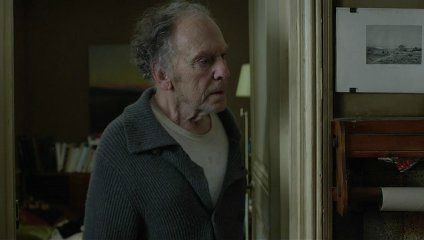
The bizarrely award-garlanded decline of a once-great director continues with Amour, Michael Haneke’s impeccably restrained but stuffily inert chamber-piece in which a charming octogenarian couple deal with the indignities of old age. Anne (Emmanuelle Riva) and Georges (Jean-Louis Trintignant) are retired music-teachers living in a large, tastefully comfortable Paris apartment – one which Darius Khondji’s cameras hardly ever leave during a picture that’s almost as claustrophobically talky as Roman Polanski’s Carnage. Their long, seemingly happy marriage has produced a single child, Eva (Isabelle Huppert), a successful musician based in London, and the pair enjoy a flinty kind of lived-in, long-worn intimacy that’s compellingly conveyed by the vastly experienced veterans Riva (Hiroshima mon amour) and Trintignant (The Conformist) – the latter making a welcome return to the screen after a nine-year absence.
When Anne suffers a sudden stroke, Georges must cope with her physical and mental decline as the woman he loves gradually recedes into dementia. “It will go steadily downhill for a while and then it’s over,” he’s informed. That prognosis arguably also applies to the film itself, Amour tracing Anne’s deterioration with a grim, clear-eyed austerity that’s undeniably moving but which becomes increasingly two-dimensional in dramatic terms. Haneke tries to add a little variation with a hallucination here and a dream-sequence there – having begun with a flash-forward prologue that strikes an incongruously enigmatic note – but these serve more to distract than illuminate.
Haneke enjoyed an astonishing run of form from 1997’s masterpiece Funny Games to that picture’s cruelly underrated Stateside remake in 2008 – with Code Unknown, The Piano Teacher, The Time of the Wolf and Hidden in between. Since then The White Ribbon (2009) and Amour have both taken the Palme d’Or at Cannes, making Haneke only the second director ever to achieve this feat with consecutive movies – although only the staunchest admirers of Swedish cinema would claim that his predecessor, Bille August, deserves a place in any current pantheon.
The White Ribbon and Amour are both professionally-handled examinations of serious, tragic subject-matter – and thus catnip for juries and critics alike. But that uncompromisingly steely cerebral brilliance that marks Haneke’s best works is now for some reason blunted and dimmed. So for all Trintignant and Riva’s excellence (what magnificently expressive faces!), Amour isn’t really so much more than a high-class TV movie, in which the ordeal of the protagonists is eased by their wealth and ability to afford private nursing.
Georges’ fraught dealings with one of these employees provides some much-needed but underdeveloped and too-fleeting friction, as well as interrupting what feels occasionally like a check-list of physical indignities familiar from previous examples of what’s becoming an overloaded sub-genre – messy mealtimes, incontinence, difficulties in the bathroom, and so on. Runar Runarsson’s Icelandic variation Volcano, which premiered at Cannes in 2011, dealt with a very similar story with a concision and low-key flair that eludes Haneke here – making it all the more frustrating that it’s yet to obtain UK distribution. Amour, by contrast, feels more like an impeccably-intentioned but dutiful plod of a picture, weighed down by the burden of doing justice to its harrowing themes.
Neil Young
7th November, 2012
for Tribune magazine
