


For ‘Tribune’: Another Earth [1/10] and IDFA film-festival report

Another Earth
Director: Mike Cahill
THE Tribune Top Ten list for 2011 will be published – deo volente – later this month, but as a taster let’s have a peek into the bottom of the barrel. In terms of films that have obtained at least reasonably wide UK distribution, a subjective run-down of the rancid would include multiplex moneymakers The Hangover Part II and Tower Heist, arthouse misfires Our Day Will Come and This Our Still Life, and, somewhere in between, the colossally disappointing Brit cop-flop Blitz.
But December, aptly enough, sees the very lamest of the year’s cinematic turkeys flapping pathetically onto our screens – one which will, if there’s any justice, by Christmas have already made the transmigration to the DVD bargain-bucket. Mike Cahill’s Another Earth is the kind of ludicrous, overwrought codswallop which gives metaphysically speculative science-fiction a bad name – one senses the literary master of the genre, Stanislaw Lem, revolving in his grave while resignedly muttering “Nie ma tego złego, co by na dobre nie wyszlo” (“Bad things often turn out to be good for you.”)
And even if it has somehow attracted critical supporters and a smattering of awards nominations Stateside since premiering at Sundance back in January, the fact that this jawdropping dreck has obtained distribution while dozens of incalculably more-deserving new films from the first half of 2011 languish silently in limbo (top of the heap: Russian stunners Innocent Saturday and Elena) is enough to make any self-respecting cinephile’s blood boil.
The poster for debutant director/co-writer Cahill’s Another Earth makes it look like some opportunistic, straight-to-video knockoff of Lars Von Trier’s Melancholia: a young blonde stands by a body of water, out of which a whole other planet incongruously looms. But whereas Von Trier’s movie presented its destructive heavenly newcomer as a straightforward but effective metaphor for his protagonist’s depressed mental state, Another Earth holds as little water as allegory as it does in terms of scientific plausibility – even given the medium’s necessary ‘suspension of disbelief.’
Because ‘Earth 2’ (as it’s dubbed) turns out to be an exact replica of our own world – right down to the people who inhabit it – hurtling towards us through space, until close enough for spaceships to make a handy-hop transit. As this is a relatively low-budget production (reportedly just $200,000), these interstellar shenanigans are essentially a backdrop for what’s supposed to be an intimate human story: a steadily-budding romance between school-cleaner Rhoda (Brit Marling, who also co-wrote the script) and classical composer/musician John (William Mapother – Tom Cruise’s younger cousin, best known for his appearances in TV’s Lost).
True love never did run smooth of course, and Rhoda and John’s amour is complicated by her guilt over having been the drunk-driver who caused the deaths of John’s child and pregnant wife in a car-smash a few years before. As Rhoda was a ‘minor’ at the time of the incident, John – we’re asked to believe – never learned her identity. So when she pays an impromptu visit to his house in order to apologise (as one does), he doesn’t recognise her. Even so, she chickens out of her confessional plans, instead posing as a cleaner sent to spruce up his neglected property.
This development is a credulity-stretcher by any measure – but it’s only one difficult-to-swallow element in what turns out to be a multi-course meal of contrivances, coincidences, plot-holes and absurdities, the whole thing presented with a kind of sanctimonious, po-faced mawkishness that ends up transforming painfully sensitive subject-matter into an exercise in crudely manipulative crassness.
One ends up feeling considerable sympathy with Rhoda’s elderly Asian co-worker Purdeep (Wes Anderson regular Kumar Pallana -, who, despairing at the ugliness of the world, or somesuch – reacts by pours “bleach in his ears… in his eyes…” Maybe he saw the rushes.
===================================================

IDFA (Amsterdam) Film Festival report
CRITICS of the British penal system who reckon our prison-inmates are cushily treated should pay a visit to San Pedro jail in the Bolivian capital La Paz. Many of the male prisoners share their accommodations with their wives and even their children, who reside within the walls of the institution voluntarily – an arrangement tolerated by the near-invisible ‘authorities’. A veritable town inside the city, San Pedro boasts makeshift shops, restaurants, sports facilities and many other facilities, as glimpsed in Diego Mondaca’s eye-opening 48-minute film Citadel (Ciudadella) – a highlight of last month’s 24th International Documentary Film Festival Amsterdam, or IDFA for short.
When Ally Derks (“the high priestess of documentaries” as she’s been dubbed) set up IDFA back in the late 80s, the idea of a film-festival exclusively devoted to non-fiction work was radical and pioneering. That’s certainly not the case these days, and while there are many successful rival events of similar stripe including Toronto’s Hotdocs, Copenhagen’s CPH:PIX and Sheffield’s Doc:Fest, IDFA remains the big daddy on the block. It has grown steadily and organically in size, all the while with Derks at the helm – an unusual degree of continuity and stability that has enabled IDFA to expand and reach out to local audiences (many screenings sell out) while retaining an intimate, quite cosy feel: gezellig, as they say in Holland.
If IDFA has a significant fault, apart from its sheer size and the occasional difficulty of getting into popular screenings, it’s that it tends to concentrate so squarely (in both senses of the word) on mainstream, conventional forms of documentary – a development which Derks seems to welcome: “they’re less dogmatic, really entertaining… We call them ‘Pop Docs,’ and ‘Docutainment,’ docs that have larger appeal and craftsmanship.”
More experimental or edgy fare almost never makes it into the numerous competitive sections – and instead is confined to the ‘Paradocs’ section (“in which the ‘periphery’ of the documentary genre takes center stage… what is going on beyond the frame of traditional documentary film-making” according to the IDFA catalogue.)
This year’s ‘Paradocs’ comprised 17 titles, but only three were longer than 30 minutes in length – and those seeking a more generous helping of challenging material would find greater satisfaction at Marseille’s equivalent docu-fest, FIDMarseille (as covered in these pages during the summer) where unorthodox stuff like Citadel is the norm rather than exception. Mondaca’s commendably bold directorial debut was shot by Andrés Boera Madrid, his digital cameras nimbly negotiating the twisty Hogarthian labyrinth that makes up San Pedro, and the resulting footage ruthlessly edited by Aldo Alvarez in a way that barrels us through the 48 minutes with an almost perverse briskness.
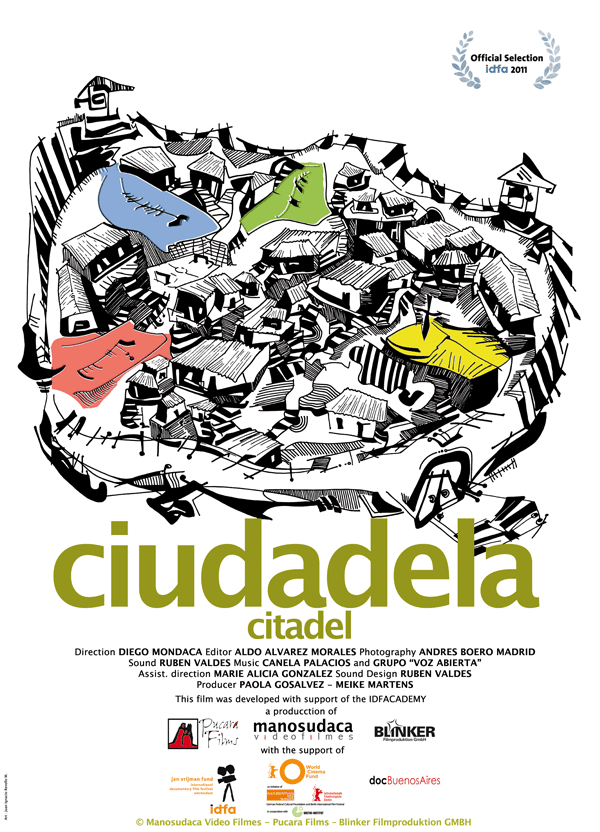
Though bracing in its rough-edged alacrity – the title’s similarity to Fernando Meirelles and Katja Lund’s City of God (2002) is surely no coincidence – Citadel is a slightly frustrating experience for the viewer, as it sparks dozens, perhaps hundreds of questions about how and why San Pedro operates as it does, without providing much in the way of answers (explanatory voiceover and captions are eschewed, though some of the residents chat about their daily lives both on and off camera). Google and Wikipedia are available, likewise Rusty Young’s non-fiction book Marching Powder, but Mondaca and company perhaps took the view that to do full justice to San Pedro’s complexities in a traditional documentary would probably involve epic length – instead presenting these jagged, impressionistic fragments.
Not that there’s anything wrong with a well-made ‘traditional’ documentary, of course, and IDFA showcased numerous examples this year – the best of which eminently deserve big-screen exposure via arthouse distribution, though many of them will no doubt pop up on the likes of BBC4 before long. Petra Epperlein and Michael Tucker’s Fightville is perhaps the soundest commercial prospect, given the burgeoning popularity in the UK of Mixed Martial Arts (MMA), an activity often dubbed ‘cage-fighting’ and given considerable tabloid prominence in recent years thanks to Katie Price’s sometime spouse Alex Reid.
Following two young MMA prospects as they make their way through the ranks, the propulsively-edited, Louisiana-set Fightville gets under the skin of this controversial sport much more successfully than Hollywood’s recent fictional attempt, Warrior, balancing the bone-crunching violence with hard-knock humour in a way that ensures appeal far beyond the sport’s own young-male demographic. It helps that both of the MMA starlets are articulate, presentable lads, and that considerable prominence is also given to charismatic, choufleur-eared MMA trainer ‘Crazy’ Tim Credeur (who on this evidence deserves a documentary all to himself) and smooth-talkingly hard-working promoter Tim Guillory.
 A rather easier ‘sell’ is presented by Carlos Botes’ The Last Dogs of Winter, which follows the attempts by a lone-wolf Canadian to revive the extinction-threatened Qimmiq, a species used by local Inuits for centuries as hunting-hounds but now abandoned in favour of motorised skidoos. The snowy wilds of remote northern Manitoba make for a stirringly picturesque backdrop for footage of the rugged but irresistibly cute Qimmiq and the polar bears who occasionally pass by – including numerous interactions that are generally playful than confrontational.
Doing their best to make an impact among such skilled four-legged scenestealers are the breeder himself, a crustily ornery hippie named Brian Ladoon, and his unflappably laid-back younger Kiwi assistant Caleb Ross (a contrasting pair, both making for great company). And while the tone is perhaps somewhat over-celebratory, with nearly every beat underlined by Tom McLeod’s overused score (excessive music the bane of far too many documentaries these days), by the end even cynophobes might find a droplet or two welling in their tear-ducts.
No less moving for its careful avoidance of sentimentality, Seung-Jun Yi’s Planet of Snail won – to nobody’s great surprise – IDFA’s headline prize, for best Feature-Length documentary. A critical and audience hit which looks set for a long tour of the world’s festivals, and not just those concentrating on non-fiction, it’s the portrait of a deaf-and-blind young poet/sculptor artist and his bubbly girlfriend, and succeeds in quietly transporting us straight into its subject’s theoretically closed-off world.
Neil Young
27th November, 2011
written for Tribune magazine
IDFA 2011 screening-diary
Citadel. [****/5]. Ciudadela : Bolivia/Germany 2011 : Diego MONDACA : 48m : {11/13}. Seen Pathé De Munt, 24th November (press/industry)
FIGHTVILLE. [7/10]. USA 2011 : Petra EPPERLEIN & Michael TUCKER : 85m : {20}. Seen Pathé De Munt, 23rd November (public – complimentary ticket)
THE LAST DOGS OF WINTER. [7/10]. New Zealand 2011 : Costa BOTES : 97m : {19}. Seen Pathé De Munt, 26th November (public – complimentary ticket)
PLANET OF SNAIL. [7/10]. S.Korea 2011 : YI Seung-Jun : 87m : {18}. Seen Pathé Tuschinski, 23rd November (public – complimentary ticket)