


for TRIBUNE: report from the 22nd FIDMarseille film-festival
Each May, the ritzy French resort of Cannes becomes the movie-world’s frenzied epicentre – when its glamorous, long-running film-festival attracts more column-inches than all the world’s similar events combined. But fame is of course no guarantee of quality – and many cinéphiles would suggest that Cannes is a hazardous place to look if one’s interested in cinema as a pure art-form.
A more plausible destination for such purposes lies just along the coast in the bustling, likeably scruffy port-city of Marseilles. This 2,600-year-old home-town of Zidane, Cantona and Fernandel – just a boule‘s throw from La Ciotat, whose train-station was in 1896 immortalised by les frères Lumiére – is best known to general film-buffs as stomping-ground of Popeye Doyle in French Connection II.
And it’s here, in July’s baking heat, that the Festival International Documentaire de Marseille – a.k.a. FIDMarseille, or just ‘FID’ – showcases an array of cutting-edge fare, the bulk of it comprising works shown in public for the first time. This emphasis on intrepid freshness makes FID a must-visit location for film-professionals – critics, directors, and other festivals’ programmers – from across Europe and beyond.
Now well into its third decade, FID – the 22nd iteration ran from 6th-11th July under the bold stewardship of long-running chef Jean-Pierre Rehm – has established a reputation for rigorous, often experimental pictures – usually tackling social, political and economic issues, frequently from thought-provokingly oblique angles. It’s an uncompromising, unorthodox programme: unusually, the three competitive sections routinely mix mid-length and feature-length material, and, despite the presence of the word ‘documentary’ in the festival’s title, many offerings blur standard definitions of fiction and non-fiction.
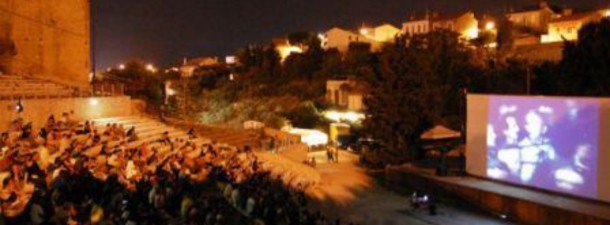
Sidebars often feature ‘straight’ non-fiction pictures, plus judicious fruits of archive-raiding – among 2011’s highlights on the latter front, a magical plein air amphitheatre screening of silent Buster Keaton vehicle The Cameraman (1928); and Jim McBride’s masterful, wildly influential example of faux-documentary from 1967, David Holzman’s Diary.
Refreshingly, FID seems to have little truck with the current international fashion for documentaries running to extreme, punishing lengths. This year’s most forbidding offering was a 146-minute filmed lecture on Terrence Malick’s favourite German philosopher Martin Heidegger – unlikely to be displacing Harry Potter at your local CineWorld any time soon.
Indeed, the overwhelming majority of FID selections are odds-against to pop up even at Britain’s most independent-minded arthouses – given the economic imperatives of the distribution system, it’s really only film-festivals which can afford to take a chance on such a wildly esoteric-sounding project as, say, Xurxo Chirro’s Vikingland.
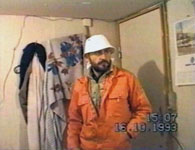 Having serendipitously stumbled across a stash of VHS tapes in his town library’s local-studies section, Chirro realised they had been shot during 1993/94 by one Luis Lomba – like Chirro, a native of the northern Spanish province of Galicia – during his time working below decks on a Danish/German ferry. What starts off as fairly banal homevideo-style larks (resulting in several walkouts before halfway at the second public screening) grows steadily more intriguing as Lomba explores the camcorder’s capabilities. He tapes extended on-the-job footage that resembles experimental video-art – and during enigmatic cabin interludes we discern a more introspective individual than the happy-go-lucky chap known by his colleagues.
Vikingland has evidently been arranged into shape by Chirro – into chapters inspired by (and named after) non-fiction interludes from Herman Melville’s seagoing classic Moby-Dick. But this is a Moby-Dick without a whale, without an Ahab – the unsettling and unexpectedly resonant results perhaps owing at least as much to the psychological parables of sailor-scribe Joseph Conrad.
While it lingers surprisingly strongly in the memory (for those of us who made it to the end, a second viewing seemed instantly desirable), Vikingland wasn’t the most accomplished debut on show at FID 2011. That honour must go to Yuval Sagiv’s How I Filmed the War, which was – astonishingly – receiving its first screenings outside its native Canada, where it premiered way back in May 2010. Admittedly, the lack of spoken dialogue might not appeal to all, but this austere “adaptation” of Lieut Geoffrey H Malins’ memoir of the same title – in which he reflects upon his experiences as the British Army’ official Kinematographer during World War One – tells a fascinating story in a radical but accessible style.
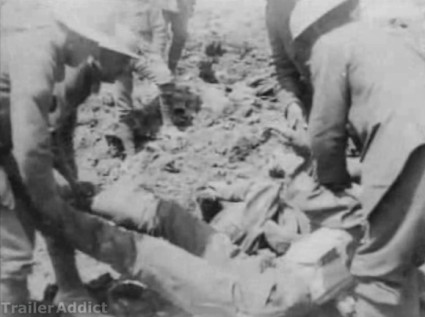
Sagiv presents excerpts from Malins’ book – phrases and sentences, in their original fonts, floating on plain white backgrounds – alongside footage from his 1916 Battle of the Somme, with additional comments from a 1993 academic text which put Malins’ claims and recollections under an analytical spotlight, penetrating what the film refers to as a “blanket of misinformation.” For a soundtrack, Sagiv deploys susurrant hums and buzzes which prove a fine complement to the elegantly stark visuals.
The result is an engrossing and illuminating examination of moving-image war-reportage in one of its very earliest manifestations – Malins was perhaps what we’d now call an “embedded” journalist – which works as both a tribute to Malins’ artistry and bravery, and in its latter stages an almost unbearably poignant reminder of Great War horrors. How I Filmed the War, one of the most effective and original documentaries of the decade so far, was Sagiv’s thesis project at university – one hopes that he received the highest possible grade for his efforts.
Another Canadian newcomer to note is Andrea Bussmann, whose 40-minute Canadian/Mexican production He Whose Face Gives No Light (Aquel cuyo rostro no irradie luz) goes behind the scenes on an upcoming Mexican feature to interview a series of OAP extras and bit-part players in between scenes. Beautifully shot on crisp digital video by acclaimed director Nicolas Pereda, He Whose Face offsets its avant-garde tendencies with a likeable strain of down-to-earth humour.
Mexico was very much in the spotlight throughout FID XXII, with a fine sidebar of archive features curated by Michel Lipkes presenting ‘Another History of Mexican Cinema’ (highlights: Nicolas Echevarria’s ethno-religious documentary Child Fidencio from 1980; Roberto Gavaldon’s enjoyably lurid melodrama/thriller Night Falls from 1952, detailing the come-uppance of an arrogant, philandering champion of that most spectacularly cinematic of sports, pelota vasca.)
And the future’s also looking bright for the USA’s vibrant southern neighbour: Natalia Almada’s The Night Watchman (El Velador) is a very fine treatment of a great subject: the contrast between the opulent tombs of deceased drug-cartel kingpins, and the rudimentary shack inhabited by the grizzled chap employed to look after them after dark. Credit where credit’s due: The Night Watchman actually world-premiered a couple of months ago down the road… in the rather gaudier setting of Cannes. Vive la différence!
Neil Young
19th July, 2011
written for Tribune magazine

Jigsaw Lounge 2011 FIDMarseille index-page
[…] Aquí lles deixo unha tradución apresuradas das palabras de Neil Young (o orixinal en inglés, aquí): (…) De feito, a inmensa maioría das seleccións do FID son rarezas mesmo para a maioría […]
[…] Aquí lles deixo unha tradución apresurada das palabras de Neil Young (o orixinal en inglés, aquí): (…) De feito, a práctica totalidade das obras seleccionadas para o FID son rarezas mesmo […]
[…] adiantar. Ademais, as virtudes de Vikingland foron louvadas por críticos de enorme prestixio coma Neil Young ou Quintín. Ningún outro cineasta galego tivo este ano o recoñecemento mundial que acadou Xurxo […]