


for this week’s ‘Tribune’ (1/2) MIDNIGHT IN PARIS and TYRANNOSAUR [both 6/10]
Midnight In Paris
Director: Woody Allen
Tyrannosaur
Director: Paddy Considine
THE list of actors-turned-directors continues to grow, seemingly exponentially. And now Paddy Considine – who’s been one of Britain’s leading screen thespians for more than a decade – joins their ranks with his tough urban drama Tyrannosaur, which deals with social and psychological problems of harrowing seriousness. Now 38, Staffordshire-born Considine’s path to the director’s chair has been a steady and careful one: after co-writing the magnificent Dead Man’s Shoes (2004), with his longtime collaborator Shane Meadows (and Paul Fraser), he both wrote and directed the 16-minute Dog Altogether (2007), which landed him with a BAFTA Film Award for Best British Short.
Like Dead Man’s Shoes, Dog Altogether deals with working-class (or even underclass) masculinity in crisis, taking us into a harsh modern Britain where violence and substance-abuse are part of everyday life. Dog Altogether essentially comprises the opening reel of Tyrannosaur, in which fiftyish alcoholic kicks his pet dog to death after an extended boozing session. He is Joseph (Peter Mullan), and while one doesn’t have to be an animal-lover to be appalled by his brutality – the attack on the dog is (mercifully) kept off-screen and conveyed by sickening sound-effects – viewers may wonder how they’re going to spend an entire movie in the company of such a reprehensible lout.
It’s Considine’s achievement, then, to make Joseph into a three-dimensional character who, while hardly likeable, emerges as deserving of our understanding and even our pity. He does this by bringing Joseph into contact with Hannah (Olivia Colman), a mousy charity-shop worker whose do-gooding Christianity initially offends the hard-drinking atheist no end. But, this being a film, initial hostilities give way to a deeper connection as Joseph – and the audience – learn about Hannah’s nightmarish domestic situation: she’s on the receiving-end of cruel abuse from her middle-class husband James (Eddie Marsan), her religion (and also her secret drinking) providing both solace and escape.
There’s hardly a character in Tyrannosaur who isn’t a victim or perpetrator of violence in some way – Joseph’s neighbours are an aggressively thuggish bunch, providing a hazardous environment for the upbringing of a kid (Samuel Bottomley) with whom he forms an avuncular bond. Even the title hints at terrible bloodshed, though the extinct lizard turns out to be the nickname Joseph affectionately used to refer to his obese, diabetic wife, now deceased – this revelation one of several stretches of dialogue which sound a little too writerly and contrived. Indeed, several of the plot developments push just a little too hard for effect, straining credulity in the proces, and in his first full-length outing Considine can’t quite balance extremes of light and dark with the aplomb of his pal Meadows – although to be fair Meadows also took three or four movies before really hitting his creative stride.
Considine, of course, has a highly successful parallel career in front of the camera to maintain – he’s got three movies upcoming in 2012 alone – but can look to his star Mullan as a template for developing both activities in tandem. Mullan’s The Magdalene Sisters won the top prize at Venice in 2002, his belated follow-up Neds achieving similar honours at San Sebastián eight years later. Abroad he’s seen as one of our leading film-makers, though at home it’s as a character-actor that he’s chiefly renowned – with a stack of awards to his name including Best Actor at Cannes in 1998 for Ken Loach’s My Name Is Joe.
This lengthy, illustrious filmography makes it somewhat ironic that Mullan, now 52, should have shared the Jury Prize for ‘Breakout Performance’ when Tyrannosaur world-premiered at Sundance back in January – although to Stateside eyes perhaps he still qualifies as an emerging talent. Colman, making an auspicious transition from the small screen (Peep Show, etc) to the large, shared the Jury Prize with her co-star – and her tremulously sensitive and moving performance is already being talked about in terms of next year’s BAFTAs. No surprise, then, that Considine should on this evidence be very much an ‘actor’s director’ – but it would be a great shame, for him and for British cinema, if he were to give up his “day job” any time soon.
AT the other end of the experience scale from Considine – at least in terms of behind-the-camera work – is Woody Allen, who now unveils his fortieth film as a director, Midnight In Paris. And that figure doesn’t include oddities like What’s Up, Tiger Lily? (1966), the jokey re-dubbing of a Japanese spy romp, his contribution to the 1989 portmanteau New York Stories or the 1994 TV movie Don’t Drink the Water. Allen’s output has always been prolific, and he’s been churning ’em out at roughly a one-a-year pace for over a decade.
Even Allen’s staunchest admirers have long since abandoned hopes of him ever coming up with another masterpiece to match the likes of Manhattan, Annie Hall and Stardust Memories, or even a near-classic such as The Purple Rose of Cairo or Hannah and Her Sisters. But in comparison with recent duds like You Will Meet a Tall Dark Stranger, Midnight In Paris can be cautiously hailed as a partial return to form – indeed, it’s provided Allen with one of the biggest financial successes of his whole career, achieving the unprecedented feat (for him) of playing in more than 1,000 North American cinemas simultaneously.
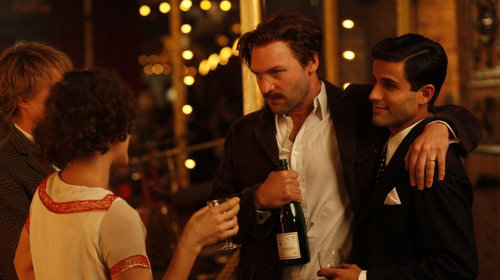
A light, rather daft fable about a screenwriter (Owen Wilson), holidaying in Paris with his fiancée (Rachel McAdams), Midnight In Paris provides a tourist’s-eye version of the French capital – at times it seems like a Fodor’s Guide come (partly) to life – that conforms to the expectations and imaginations of ageing Americans whose view of the city is primarily formed by reading about the Lost Generation and their ilk. Our hero Gil, though only in his thirties, is clearly of a similar temperament, and this young fogey wanders the streets wishing he was back in the days of Fitzgerald, Hemingway, Dali and Gertrude Stein. So vehement is his desire to escape into the past that, by some unexplained miracle, he’s able to do so every night – if he’s in a certain secluded spot as the clock strikes midnight, a 1920s car pulls up and transports him back to what he views as the Golden Age: allowing him (and us) to hang out with his idols.
Rising British star Tom Hiddleston makes a droll Fitzgerald, Marion Cotillard is on hand to provide a bit of bygone, flapper-esque love-interest, Kathy Bates’ doughty Stein helps Gil out with his long-gestating novel, and Adrien Brody pops up as a nincompoopish Dali. But it’s a near-unknown, Corey Stoll, who steals the movie as a swaggeringly charismatic, irresistibly blow-hard Hemingway – his brief appearances making such impact that one rather wishes Allen had set the whole thing in the 20s, with Hemingway as the focus and Gil ‘calling in’ from the distant future.
That said, it’s always nice to see time-travel – so often a recipe for complexity and confusion in the movies – treated with such offhand nonchalance, and the gimmick sets up one hilarious gag involving a private-detective who follows Gil through his ‘wormhole’, then on into various previous ‘Golden Ages’. The moral being that there is no Golden Age, and that nostalgia is just a cosy retreat from the tricky demands of an ever-changing present. Coming from Woody Allen, of course, such life-lessons are a little hard to swallow. But Midnight In Paris, with its starry cast (Carla Bruni has an extended cameo as a museum-guide), genial lead and wistful air, is certainly a nicely sugared little amuse-bouche.
Neil Young
27th September, 2011
written for Tribune magazine
