


for this week’s TRIBUNE: ‘THE TURIN HORSE’ [6/10]; ‘HIMIZU’ [5/10]
Himizu
Director: Sono Sion
The Turin Horse
Directors: Tarr Bela & Hranitzky Agnes
Two new releases this week feature animals in their titles, hail from lands where surnames are written first, and won prizes at leading 2011 film-festivals. But those aren’t the only connections between Sion Sono’s Himizu from Japan and The Turin Horse, the latest – and reportedly last – feature from Hungarian maestro of misery Tarr Bela, officially co-directed (like almost all of his features) by his wife and editor, Hranitzky Agnes.
Both pictures deal with apocalyptic scenarios: shot in stately monochrome The Turin Horse unfolds in and around a farmstead in 1890s eastern Europe permanently blasted by hurricane-strength winds, where sources of food, energy and hope are rapidly dwindling towards zero. Himizu, named after a type of mole native to the Japanese archipelago and an altogether scrappier, raggier affair, is set in the immediate aftermath of the 2011 earthquake and tsunami that devastated whole swathes of the coastline, at a time when dire reports of the Fukushima nuclear-reactor were starting to come over the airwaves.
The protagonists of the two films display very different reactions to the nightmarish situations in which they find themselves. The Turin Horse‘s middle-aged Ohlendorfer (Derzsi János), a monosyllabic curmudgeon with only the use of one arm, clings stubbornly to the routines of farm-life – aided by a thirtyish long-suffering woman (Bók Erika) who may be his daughter or grand-daughter. The duo have the chance to quit this zone of despair when a band of raucous gypsies roll by and offer an escape-route – one which is brusquely spurned by the anti-semitic farmer. Instead the duo hunker down to their fate as their well runs dry and their potato-stock diminishes – leaving only their old grey mare as a potential route from starvation.
This attitude of glum fatalism is shared by many of the supporting characters in Himizu – adults who retreat into alcohol, violence and complaint as they ponder the vicissitudes of nature and the unexpected fragility of their prosperous civilisation. But fortunately the younger generations have rather more gumption – indeed, downtrodden 14-year-old Sumida (Sometani Shôta) is presented as a potential secular saviour for the nation. He’s a rare and valuable residue of the mysterious Japanese life-force known as genki, usually defined as a kind of indomitable can-do positivity, and which has been crucial to the nation surviving several cataclysms over the centuries.
Sumida, however, isn’t the most dynamic of individuals – he’s an anything-for-a-quiet-life sort at heart, the mole of the title referring to his preferred low-key, out-of-sight attitude towards activity. He’s mainly spurred on in reaction to his abusive no-good-nik estranged father, and by the cheerleadingly amorous attentions of schoolmate Keiko (Nikaidô Fumi) – a hyperactive chatterbox whose manic cheerfulness gratingly borders on hysteria. Both actors were recognised as the most promising younger performer at Venice last year, and while Sometani – even though visibly a half-decade older than his character – displays precocious screen-presence, a little of Nikaidô’s perky schtick goes a long way.
Then again, Sono’s modus operandi is one of arduously confrontational excess in numerous areas, his 129-minute film – based on a 2001/2 manga comic by Furuya Minoru and hastily rewritten mid-shoot to take into account the cataclysmic events of February 2011 – losing its focus by pushing situations and characters to near-parodic extremes. As a temperature-taking of Japan’s social zeitgeist at a juncture of great upheaval, Himizu is a fascinating and valuable document. As a piece of dramatic narrative cinema, however, its shril tonal waywardness renders it more a curio than a coherent statement of existential themes.
The Turin Horse, by contrast, feels worked over and refined to the nth degree by Tarr, Hranitzky (who also edits the picture), cinematographer Fred Kelemen (himself a director of some note) and co-writer Krasznahorkai László. This is slab-like, monolithic cinema of the Old Testament school – an unapologetically dour and demanding journey into a situation of bleak despair which picked up the Silver Bear (or runner-up prize) behind Asghar Farhadi’s rather more “accessible” A Separation at Berlin in February 2011.
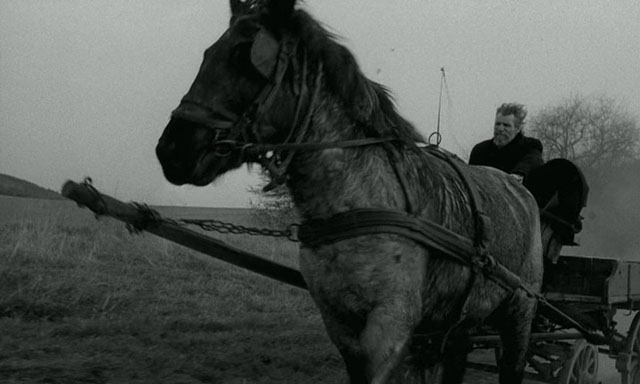
Supposedly based on an anecdote involving Friedrich Nietzsche and an incident of animal cruelty he witnessed in the title’s northern Italian city, it begs metaphorical and even theological interpretations – though it’s perhaps most interesting in its treatment of the female character(s): the daughter/grand-daughter and the majestic grey mare, hard-driven workhorses the pair of them. The extended opening shot, in which Ohlsdorfer is shown driving the beast along the country lanes homeward, is a magnificent coup de cinema unmatched by anything that follows, one which partly justifies the sky-high reputation enjoyed by Tarr among certain highbrow critics. Hranitzky, unfortunately, tends to get a bit overlooked amid such encomia – somewhat ironic, given the way The Turin Horse goes out of its way to depict and laconically celebrate the capacity for work and endurance of the ‘fairer’ sex.
Neil Young
20th May 2012
written for Tribune magazine