


Notes on the world premiere of Ben Rivers’ TWO YEARS AT SEA (Lido di Venezia, 9.9.11)
To paraphrase Voltaire’s quip about the Holy Roman Empire, the phenomenon generally referred to as ‘Venice Film Festival’ doesn’t actually take place in Venice, and it isn’t technically a Film Festival. Unspooling on various buildings at the Lido, an island which is a good twenty-minute vaporetto ride from Venice itself, the event was founded in 1932 as an offshoot of the Biennale – the more general showcase of contemporary art which takes place every two years and which dates back to 1895. And it has never been officially referred to as a Film Festival – initially labelled the Esposizione Internazionale d’Arte Cinematografica it is now the Mostra Internazionale d’Arte Cinematografica, literally an international display of cinematic art.
Nearly eighty years later, cinema is still viewed in certain quarters as a somehow subsidiary, inferior art-form – a bastardised, commercialised, compromised medium which, in its relative infancy, has yet to ascend to the higher planes long since occupied by, say, painting, classical music, and literature. Professing ignorance of Titian, Bach or Proust in sophisticated, educated circles would lead to raised eyebrows – but detailed knowledge of, say, Tarkovsky, Mizoguchi and Murnau remains the preserve of buffs and cinéphiles.
Cinema, it must be said, often proves its own worst enemy in this regard, treating its most exquisite manifestations with a casual carelessness which would never be allowed in painting, for example. Take Two Years At Sea by Ben Rivers, one of the most eagerly-awaited world premieres in the Orizzonti sidebar of Venice 2011. Somerset-born, London-based Rivers has gradually established himself as a major figure in European – and indeed world – art-cinema over the past decade with his shorts, shot on 16mm, often chronicling – in semi-documentary fashion – the lives of figures on the margins of society.
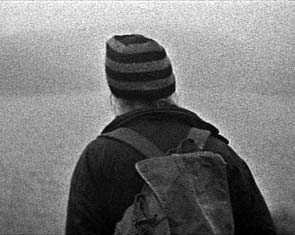
This Is My Land (2006) was an intimate portrait of Jake Williams and his hermit-like existence in the middle of Aberdeenshire’s forests, and Two Years At Sea, Rivers’ first feature-length work, is a 90-minute variation on similar themes, with only one line of audible dialogue (“chesty cough,” mumbles Jake, examining a bottle of expectorant.) A hoarder of old photographs, Williams seems to have progressed to a point beyond language, exploring his damp surroundings on daily hikes with which the unacknowledged Rivers gamely tags along.

As the Venice catalogue notes, “the raw film footage provides Rivers with a starting point for creating oblique narratives imagining alternative existences in marginal worlds. Rivers often hand-develops the 16mm film, which shows all the evidence of the elements it has been exposed to – the materiality of this medium forming part of the narrative.”
But while Two Years At Sea was announced as being shown via a 35mm print – the end credits (which, tellingly, start with the stark words ‘Film by Ben Rivers’) include mention of blow-up from 16mm – in the event it was screened digitally, thus ignoring and indeed contradicting “the materiality of this medium.” No apology or explanation was made before the premiere, which was preceded by Rivers and key collaborators being introduced to the audience by a tannoyed voice. Subsequent investigations yielded the (depressingly predictable) information that the 35mm print “wasn’t ready in time” for the festival, requiring that a digital ‘alternative’ be shown.
While digital might arguably be a suitable format for the likes of Tinker Tailor Soldier Spy and Carnage – Venice competition films which were shot on 35mm but screened via Digital Cinema Package – in the case of Two Years At Sea, the new medium simply doesn’t come anywhere near cutting it. Williams himself is emphatically an analogue kind o’ guy – he listens to scratchy albums via an old-school phonogram – and Rivers’ visualisations of his world rely on the imperfections of celluloid (‘flaws’ from the development process abound in the finished film.)
The rough magic of Two Years At Sea depends to a significant degree on microscopic variations of light and shade which digital can only partially and unsatisfactorily capture: sunset and sunrises, then the remarkable, extended final shot in which Williams’ face, illuminated only by a campfire, gradually disappears into total blackness.

The 35mm print will presumably be ready in time for Two Years At Sea‘s UK premiere at the London Film Festival in October. And the Venice digital screening was, it could perhaps be argued, ‘better than nothing’ – the international press jury still managed to award Rivers their prize for the Orizzonti section – but it is surely unacceptable than a ‘display of cinematic art’ should so disregard an artist’s particular, well-established vision.
Imagine the furore if, say, Chris Ofili’s paintings shown in the British Pavilion at the 2003 Biennale hadn’t been quite “finished in time” to be transported to Venice, and were instead replaced by digital representations. Patrons would of course have gotten the rough idea, would have gotten Ofili’s gist, but they wouldn’t be seeing the art. Such substitutions simply would not be tolerated in any other art-form. Why should cinema be different?
Neil Young
11th September 2011
further reading: Ben Rivers and the Abolition of Time (August 2011 article/interview for FIPRESCI, mainly on Sack Barrow, touching on matters digital).
