


for this week’s Tribune : INDIELISBOA 2009 report
The Festival Internacional de Cinema Independente – IndieLisboa for short – is, as its name promises, a fine showcase of international "independent" cinema. But anyone visiting the event, whose sixth renewal ran from April 23rd to May 3rd, is missing out if all they do is see movies. Because whereas there isn't much else going on in, say, Rotterdam in January – ensuring attendees of that city's major festival routinely cram six or more films into days that will start around 10am and finish after midnight – Lisbon in late spring is a different matter entirely.
And the festival-organisers certainly make it pretty easy for everyone to sample the delights of this ancient, beautiful, incredibly hilly capital – most days the first screening (apart from kiddie matinees) kicks off at 3pm. That said, many IndieLisboa-goers tend – in true Portuguese-style – to rise late, having sampled the countless late-night options available such as venerable city-centre cabaret-club Maxime's on the Praça da Alegria.
In bygone days Maxime's denizens were often theatrical sorts from the nearby Parque Mayer – Lisbon's mini-Broadway, now a ghostly shadow of its former self. There's only one functioning theatre remaining, the Maria Vitória, whose gaudy frontage I'd walked past dozens of times before venturing beyond it into the (never very park-like) 'Parque' itself.
As one online commentator has noted, wandering the near-deserted Parque Mayer – an oasis of eerie calm right in the city's heart – is "like being on a David Lynch film set". The landscape is dominated by the once-majestic, now-dilapidated Cinema Capitolio, with the shells of old theatres here and there, a small street of shacks, and the only sign of life (apart from the colony of semi-feral cats) a small family-run diner named Gina's.
Out the back of Gina's – a delightful spot which can't exactly get much passing trade, but serves filling, reasonably-priced simple local dishes – is an overgrown pathway which, I was told, leads to the rear of the stunning Portuguese cinematheque (Cinemateca Portugesa). The latter – one of Europe's great temples of cinema – is opulently located in a former townhouse/mansion, and thanks to generous government subsidy the standard ticket price is a jaw-dropping ‚¬2.50. I caught a matinee of Errol Flynn and Ann Sheridan in Raoul Walsh's 1949 frontier western Silver River – just the kind of thing that would have lit up the Capitolio in its prime. The latter is reportedly to form centrepiece of a redeveloped Parque Mayer, though the ambitious plans – involving (inevitably) America's megastar architect Frank Gehry – are reportedly (and mercifully) on hold due to financial and planning considerations. In any case, best to get to Gina's while you still have the chance.
I might never have stumbled across Parque Mayer had it not been for Ruins (Ruinas), a brand-new essay-documentary by Lisbon's own Manuel Mozos. Now 50, Mozos is revered in local film circles – despite reportedly leaving most of his projects unfinished – and works as an archivist at the Cinemateca. Awarded the prize for Best Portuguese Film, Ruins is a fragmentary collage in which Mozos tours various locations in the country which have seen better days – abandoned houses, hospitals, hotels – including Parque Mayer. Though it's a touch too bitty and pretentious for my taste, with its narration a dense collage of poetic texts and the material perhaps overstretched even at a running-time of one hour, Ruins is a fine example of how cinema can lead us to explore the "real" world with fresh eyes.
If Ruins feels very much like a film made from a perspective of aged experience, Joao Rosas's Birth of a City is decidedly a young man's movie, and none the worse for that. This debut feature of 28-year-old Rosas – another world premiere for IndieLisboa – is essentially a documentary with lightly fictional elements, about a young Portuguese film-maker (heard but unseen) living in scruffy east London, wandering the streets with his camera.
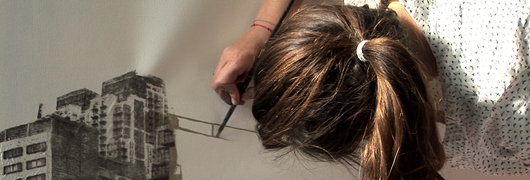
During his peregrinations he comes across a young French woman who paints imaginary cities – and the creation of her latest canvas is intercut with images of the real London, and also of Lisbon when the director visits home. Marked by a gentle, observant curiosity and a beguiling compositional eye that helps us digest Rosas' stream of intellectual/philosophical musings, Birth of a City is a kind of Hackney Mon Amour with a Patrick Keiller touch – and IndieLisboa will hopefully mark the beginning of a long tour of those film-festivals which favour the offbeat and the adventurous.
There'll also be plenty of takers for Visionary Iraq, a teasingly "naughty" and ostentatiously transgressive assault on decency from highly-regarded American/Portuguese 25-year-old Gabriel Abrantes, here sharing nearly all duties on both sides of the camera with Benjamin Crotty. A deliberately artifical, mannered and soapily melodramatic kaleidoscope of sibling incest, post-colonial guilt and the nefarious capitalist manipulations of the military-industrial complex, it packs more ideas and outrage into its 17 minutes than most features manage in 100.
Closer to home, Dublin-born Glaswegian Duncan Campbell takes a similarly confrontational approach with his experimental documentary Bernadette, an edgy and daringly unconventional portrait of 1970s Northern Irish politican Bernadette Devlin that sandwiches archive footage between much more radical and oblique opening and closing sections. Clocking in at 37 minutes, as a treatment of Northern Ireland's recent history Bernadette makes Steve McQueen's Hunger look positively timid in comparison, even if not all of its bold gambits quite come off.
There was nothing quite so bracingly transgressive among the new features on show – among a strong competition, I'd already seen (and liked) the main prize-winner, Lance Hammer's hard-hitting American indie Ballast at Berlin last year and had caught the new Argentinian films Mariano de Rosa's (terrific) Green Waters and Celina Murga's A Week Alone at Berlin ('09) and Vienna respectively.
Pick of the new discoveries was Breathless, the rather audaciously-titled gangster thriller by writer-director-star Yang Ik-June. Though a bit long, and a touch slow here and there, it's easy to see why this uncompromisingly violent, exceedingly foul-mouthed tale of an amoral small-time hoodlum and the schoolgirl he befriends became one of the 'buzz' pictures at Rotterdam back in January. It's premiering here at the Edinburgh film-festival later this month, and looks a safe bet to be the next big cult hit from the febrile cinematic hotbed that is East Asia.
Neil Young
26th May, 2009
written for the 3rd June edition of Tribune magazine
Jigsaw Lounge's IndieLisboa 2009 index page

features
BIRTH OF A CITY : [7/10] : UK/Portugal 2009 : João ROSAS : 76m (timed)
BREATHLESS : [7/10] : Ddongpari : (South) Korea 2008 : YANG Ik-June : 130m
RUINS : [6/10] : Ruínas : Portugal 2009 : Manuel MOZOS : 60m (timed)
shorts
Bernadette : [7/10] : UK 2008 : Duncan CAMPBELL : 37m
Visionary Iraq : [7/10] : Portugal 2009 : Gabriel ABRANTES & Benjamin CROTTY : 20m
features also seen (comment upcoming)
ALICIA IN THE LAND : [6/10] : Alicia en el pais : Chile 2008 : Esteban LARRAIN : 86m
THE APPRENTICE : [6/10] : L'apprenti : France 2008 : Samuel COLLARDEY : 82m
CRITIC : [6/10] : Critico : Brazil 2008 : Kleber Mendonça Filho : 82m
FILM IST. a girl & a gun : [4/10] : aka FILM IS. a girl & a gun : Austria 2009 : Gustav DEUTSCH : 93m
FILM IS. A GIRL & A GUN : [4/10]
HELP GONE MAD : [5/10] : Sumashedshaya pomoch : Russia 2009 : Boris KHLEBNIKOV : 118m
LIFE AT A DISTANCE : [6/10] : La vie lointaine : France 2008 : Sébastien BETBEDER : 54m
THE PRINCE OF BROADWAY : [5?/10] : USA 2008 : Sean BAKER : 100m
sûden : [6/10] : Argentina 2008 : Gastón SOLNICKI : 67m : Londres