


for this week’s Tribune : ‘Cold Souls’ [7/10] and ‘Harry Brown’ [4/10]
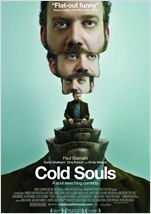
Cold Souls
Director: Sophie Barthes
Harry Brown
Director: Daniel Barber
It may not be the most inviting of titles – especially on a wet November evening – but deft metaphysical comedy Cold Souls reminds us that surface impressions only tell part of any story. This debut feature from writer-director Sophie Barthes stars Paul Giamatti as himself, or rather a fictionalised version of himself. And part of the joke is that, while many viewers will be familiar with Giamatti's lugubrious face from numerous big-screen appearances in recent years (he was Oscar-nominated for his supporting turn in Cinderella Man, and won numerous awards for his co-lead performance in Sideways), he's not exactly "famous" as such.
This means that Barthes has considerable latitude to concoct a fanciful, quietly science-fictional tale around Giamatti's established screen persona: a combination of nervousness and gloom, Giamatti/"Giamatti" is clearly ambitious with regard to his career but intelligent and objective enough to realise that Hollywood stardom is (a) high unlikely and (b) highly undesirable.
In the film, "Giamatti" has reached a creative impasse during rehearsals for a Broadway production of Uncle Vanya. His solution is unorthodox: after reading about a futuristic form of surgery, he undergoes a painless procedure whereby his soul – in a super-compacted form which, as "Giamatti" wryly notes, resembles "a chickpea" – is extracted and kept in storage. The "unburdened" "Giamatti" immediately notices considerable differences – as does his bemused spouse (Emily Watson – not playing herself.) Unforeseen complications ensue when "Giamatti" is offered the chance to temporarily carry the soul of an actual Russian poet, all the better to get into the proper Chekhovian spirit. This leads to his becoming messily entangled with St Petersburg criminals who are engaged in an unusual form of "trafficking"…
As the latter detail indicates, the narrative of Cold Souls leaves itself open to – indeed, actively demands – allegorical interpretation. The soul-extraction business – as conducted under the avuncular eye of Dr Flintstein (David Strathairn, superbly droll) in an amusingly Kubrick-sterile corporate environment ("conveniently located on Roosevelt Island" adjacent to Manhattan) – is, for example, both a parody of new-age remedies and also a sly dig at the predilection of Americans, especially American celebrities, for outlandish, often surgical solutions to their personal and professional problems.
It's the kind of thing that could easily be played as zany, cockeyed weirdness – but Barthes, deploying a palette of greys and cobalt blues for both Stateside and St Petersburg locales, wisely keeps the temperature pretty cool throughout. Exploring bizarre concepts, characters and situations with a deadpan matter-of-factness results in a likeably offbeat affair that's frequently funny and occasionally hilarious, thankfully avoiding the self-consciousness and clever-clever, overcooked feel that marred Charlie Kaufman's recent, not-so-dissimilar Synecdoche, New York.
Of course the most obvious predecessor for Cold Souls is the Kaufman-scripted Being John Malkovich (1999): at times, it seems as though Barthes is deliberately homaging Spike Jonze's delirious modern masterpiece of philosophical comedy. While any comparison between the two films can't be to Barthes' advantage, Cold Souls is a certainly cut above the majority of American comedies seen on our screens in recent months – and anyway, isn't it appropriate that this particular movie's own "soul" should be something of a creative "buy-in"? Also, if every generation can get its own remake of Invasion of the Body Snatchers, there's surely no reason why the arthouse crowd shouldn't get, once a decade or so, such a dryly delightful reprise of Malkovich's self-referential soul-snatching.
One rather less welcome – but evidently inescapable – revenant is the urban vigilante picture, which has been popping up in our cinemas (and, more recently, television) with increasing regularity since the "daddy" of the sub-sub-genre, Michael Winner's Death Wish (based on Brian Garfield's novel) so cleverly exploited the fears of middle-class, mid-seventies America. 2007 alone brought us Kevin Bacon in Death Sentence (nominally based on Garfield's followup) and Jodie Foster in The Brave One, presenting American cities as crime-infested dystopias where decent folk are driven to desperation and violence. Given current trends, it's no surprise to learn that a Death Wish remake is on Sylvester Stallone's agenda – he describes the original as "a classic morality tale, where you take a civilized man and take away everything that matters to him so he becomes primitive again."
And this is the essential plot of Harry Brown, a grim and supposedly gritty vision of today's London in which a respectable pensioner – Michael Caine in a title-role whose echoes of 'Harry Palmer' are clearly no coincidence – takes the law into his own hands following the murder of his best mate by a pack of feral youths. "Do you reall think Mr Emphysema's got it in him to top a load of hoodies?" asks a baffled (and, needless to say, utterly ineffectual) copper. The answer lies in this mild-mannered widower's personal history in the military, including hints of dark deeds in Northern Ireland. Indeed, the film does seem to suggest that some of the more extreme tactics employed by the British Army in Ulster might well be the solution to certain present-day mainland problems in what is theoretically peacetime, but which the film-makers present as an undeclared war between classes and generations.
In the vein of rabble-rousing, prejudice-exploiting fare like the rancid Eden Lake and the unapologetically thick-ear Outlaw, Gary Young's screenplay is social analysis of the Richard Littlejohn school: a quasi-realist phantasmagoria of 'Broken Britain' given unwarranted class by Martin Ruhe's unsettlingly ominous cinematography (he also shot Control) and Caine's characteristic downplaying of even the most emotionally extreme scenes.
It is of course encouraging that this living legend of British cinema should be, at this late-autumn stage of his career, willing to depart so dramatically from the relative cosiness of "nice" films like his last outing, Is Anybody There? and seek out more confrontational material. Just a pity that his search for creative challenges (and, as he admits, a first Best Actor Oscar to add to his two supporting-role statuettes) should have led him to such a thuddingly opportunistic, two-dimensionally exploitative script.
Neil Young
3rd November, 2009
written for the 11th November issue of Tribune magazine

COLD SOULS : [7/10] : US/Fr 2009 : Sophie BARTHES : 101m (BBFC) : seen 3rd October 2009, Empire cinema, Great Park, Birmingham (press show – 62nd CinemaDays event). [19/28]
HARRY BROWN : [4/10] : UK 2009 : Daniel BARBER : 103m (BBFC) : seen 3rd October 2009, Empire cinema, Great Park, Birmingham (press show – 62nd CinemaDays event). [9/28]