

for Tribune: brief notes on seven Cannes 2013 main-competition features
Brief notes on seven films shown in the main Competition of the 66th Cannes Film Festival, presented in order of preference.
Only Lovers Left Alive (director: Jim Jarmusch, USA) 7/10
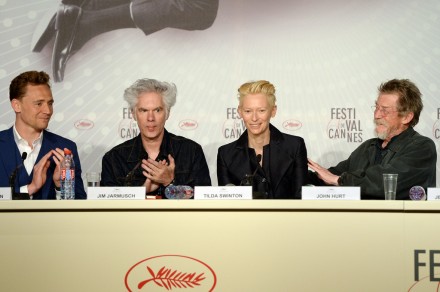
In a Cannes overloaded, as usual, with po-faced sturm und drang, the latest coolly comical confection from Ohio’s bequiffed sultan of hip beguiled with its offhand erudition and sauntering, stylised poise. A languid vampire romance set in Tangiers and Detroit, it features Tilda Swinton, Tom Hiddleston and John Hurt – flying the Blighty flag in a year when no British director was considered worthy of competing for the Palme d’Or. And with this ultra-classy cast perfectly in tune with Jarmusch’s sardonic but essentially soft-centred wit Only Lovers is a rare case of a picture which not only plainly strives for cult-classic midnight-movie status, but pulls it off with disarming aplomb. (Prizes: none.)
Inside Llewyn Davis (Ethan and Joel Coen, USA) 7/10
Twenty-two years after Barton Fink pretty much swept the board on the Croisette, the Coens’ follow-up to their biggest ever commercial success – True Grit – nabbed the Grand Prix (i.e. silver medal) from Steven Spielberg’s jury. Fair recompense for one of the very few Palme contenders to reap near-universal approval. It showcases a genuinely star-marking turn from Guatemala-born 33-year-old Oscar Isaac (The Bourne Legacy; W.E.; Drive), whose eponymous Davis is a folk musician hovering agonisingly on the edge of the big time in early-1960s New York. What begins in the breezy register of O Brother, Where Art Thou? darkens nicely towards bleaker, more unsettling – more “Fink-ish” territory – after Davis embarks on a nightmarish road-trip. But don’t hold your breath for the UK release – Inside Llewyn Davis doesn’t open here until the end of January.
Grigris (Mahamat-Saleh Haroun, Chad/France) 7/10
Films from ‘obscure’ countries which fail to land high-profile awards at the major festivals often struggle to obtain UK distribution. And given the current dicey state of distribution, arthouse cinemagoers may not get the chance to discover the latest by Chad-born, France-based, 52-year-old Haroun, whose A Screaming Man won Cannes’ Prix du Jury in 2010. One of the more polarising titles on the Croisette, Grigris is set in Chad’s bustling capital N’djamena and built around a remarkable physical performance by newcomer Souleyman Deme. Despite a withered leg, Deme – whose character shares his name, and is nicknamed ‘Grigris’ – burns up his local disco’s dancefloor every weekend, in scenes that pay explicit homage to Saturday Night Fever. Melodramatic complications cloud the happy-go-lucky Deme’s horizon, involving an ailing stepfather, a petrol-smuggling ring and a comely sex-worker, leading up to an audaciously abrupt but wryly satisfying and intriguingly complex finale.

Borgman (Alex van Warmerdam, Netherlands) 7/10
Many reckoned Grigris might be tossed some kind of consolation bone by Spielberg’s jury, but the latest provocation from Dutch veteran Van Warmerdam was always seen as a bit to way-out to receive the official “seal of approval.” A darkly hilarious variant on the honourable suburban-infiltration sub-genre (think Boudu Saved From Drowning, Theorem, Brimstone and Treacle) it follows the machinations of a Machiavellian, perhaps even satanic quasi-tramp as he finagles his way into a moneyed, dysfunctional bourgeois household. If Grigris takes off in its final act, Borgman undeniably fizzles – but by this stage Van Warmerdam, with his elegantly swaggering brand of envelope-pushing (part Lars Von Trier, part David Lynch) has done more than enough to justify what was, remarkably, Holland’s first Palme competition slot in 38 years.
Nebraska (Alexander Payne, USA) 6/10
76-year-old Hollywood veteran Bruce Dern (Coming Home; The Great Gatsby; all manner of Roger Corman cheapies in the sixties) became the oldest ever winner of an acting prize at Cannes for his crustily taciturn central performance in this black-and-white road-movie – one which, despite the title, has nothing to do with Bruce Springsteen. As with previous pictures by Payne (The Descendants, About Schmidt, Sideways), the tone is an odd, occasionally discordant mixture of the humanistic and the misanthropic, with low-key, well-observed characterisation jarringly juxtaposed with broad-strokes belly-laughs. But the ever-wonderful Dern’s determinedly unsentimental turn compels interest, and his Cannes triumph confirmed his welcome status as an early front-runner for the Oscars – with Stacy Keach’s scenestealing contribution as Dern’s former compadre also likely to earn attention from the Academy.
The Immigrant (James Gray, USA) 5/10
Gray has long been hailed as the ‘next Scorsese’ by French critics, and has now been in competition on the Croisette no fewer than four times. But like its three predecessors, claustrophobically intense period-piece The Immigrant went home empty-handed, the jury-room debates evidently mirroring the largely tepid reaction among the press. And while it found favour among certain Gray die-hards, most English-language reviews praised only the lead performances from Marion Cotillard (as Ewa, a Polish woman struggling to get by in early-1920s New York) and Joaquin Phoenix (as Ewa’s apparent benefactor, whose “help” leads her down the path of prostitution.) Lacking the edge and sparkle that elevated Gray’s 2007-8 double-whammy We Own the Night and Two Lovers, The Immigrant is a strangely inert enterprise, bogged down in a quest for atmospheric verisimilitude, and unable to transcend the fundamental inadequacies of its contrived, manipulative storyline.
Heli (Amat Escalante, Mexico) 5/10
For the second year running, Best Director went to a relatively youthful representative of Mexico’s currently vibrant scene. But where Carlos Reygadas’ Post Tenebras Lux stumbled disastrously into experimental self-indulgence, Escalante’s gruelling examination of the War On Drugs’ disastrous impact on rural communities adheres slavishly to current “slow cinema” trends. Despite gaining instant notoriety for a graphic torture scene featuring flambeéd male genitalia (simulated), and another sequence which involves the casual killing of a cute little dog (ditto), Heli was overall a lukewarm, undistinguished effort whose presence in competition helped fuel the ongoing debates about who got excluded (of the 20 competing directors, only one was female; no Brits)… and why.
[more on Heli here]
The other main prize-winners: A Touch of Sin (Jia Zhangke, China), Best Screenplay; The Past (Asghar Farhadi, France/Iran), Best Actress – Berenice Bejo; Like Father, Like Son (Hirokazu Kore-eda, Japan), Prix du Jury; Blue is the Warmest Colour (Abdellatif Kechiche, France), Palme d’Or.
Neil Young
5th June 2013
written for the 13th June edition of Tribune magazine
