


FID AS A FIDDLE: MICHAEL PATTISON GETS LOST IN MARSEILLES
“I’d like to pull the goddamn city down brick by brick and put it all in your fuckin’ head!”
Popeye Doyle, French Connection II
– – – – – – – – – – – – – – – – – – – – – – – – – – – – – –
I’m the sort of chap who makes favourites lists. I’m the sort of chap who doesn’t distinguish between favourites and bests. Those who do distinguish between favourites and bests subscribe to the obviously crazy idea that their personal tastes do not belong to or share the same history or cultural space as the canon whose apparent and often disgusting authority they happily reinforce.
Those crazies aren’t for me. They value and speak of technical precision, narrative innovation, historical importance, social significance and other nebulous abstractions as much as I do, but their (or our) arguments as to why, say, Ozu Yasujirô’s films are innately stronger than Michael Bay’s can never go beyond the subjective parameters of personal preference. Which is to say treating canons as anything other than a loose viewing guide is total horseshit. Which isn’t to say my own cinephilia hasn’t been formed by the odiously helpful and helpfully odious dung heap of critical consensus. There were five Hitchcocks in my most recent top ten.
The French Connection is my favourite film. I first watched it the morning after the 2001 or 2002 Oscars ceremony; the BBC last broadcasted the awards live in Britain in 2003, and I’ve never had Sky. The 1971 masterpiece aired directly before the ceremony took place, and I recorded it onto a blank video-cassette. I’ve often claimed the film catalysed my deeper engagement with movies, but in truth I must have had cinephilic urges deep enough to tape it in the first place. (I have maintained a hand-written viewing log since 1 January 2005. My memories of film-watching prior to then are open to hazard as well as romance.)
At any rate, The French Connection was one of the most gripping films I had at that point seen, and though I’ve had several favourites since—Le Samouraï (1967), The Godfather (1972), Breathless (1960), Taxi Driver (1976), Lost in Translation (2003), Eraserhead (1977) and so on—William Friedkin’s policier has been a reliable constant, the one to which I’ve returned most regularly and satisfyingly. It’s the finest film I’ve ever watched. It’s the best film ever made.
Let’s say I first watched The French Connection aged 15 or 16. I’m now 26. Ten years is a long time for a film to embed itself deep enough to endure the tumultuous fluctuations between adolescent fads. Fitting, then, that the Marseilles locales featured in the film—and also those in John Frankenheimer’s 1975 sequel, simply titled French Connection II—look appreciably unchanged today. I got to roam France’s second largest (and third most populous) city while attending the 25th edition of FIDMarseille (FID), whose emphasis upon non-fiction films enables it each year to showcase and thus immortalise numerous socio-historical snapshots.
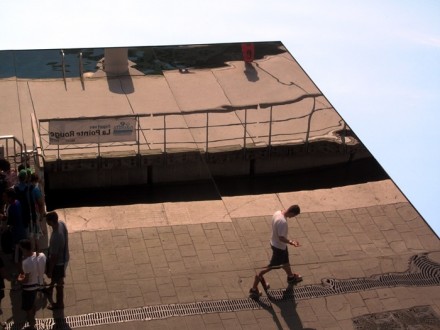
Among those screening at FID this year was Tsai Ming-liang’s Journey to the West, in which the director’s regular leading performer, Lee Kang-sheng, is accompanied by Denis Lavant in an amusingly snail’s pace progression through the various nooks and crannies of Marseilles itself. Some locations appear to be more public than others. Tsai, a master shot-composer, disorients us early in the film with a skyward-pointing, upside-down camera placed beneath Port Vieux Pavilion, a horizontal mirror that sits atop six pillars above the public space of Marseilles’s Old Port.
Port Vieux Pavilion is almost 150 long. Its stainless steel canopy was designed by London-based architectural and integrated design firm Foster + Partners. Foster + Partners was founded in 1967 by Norman Foster. Norman Foster had formerly been part of Team 4, among whose notable architectural achievements is Skybreak House in Radlett, Hertfordshire, whose interior featured in Stanley Kubrick’s A Clockwork Orange the same year as The French Connection.
For the purposes of a pre-film festival ident, Lee walks, as he does in Journey to the West, along a distinctively-walled corridor in one of FIDMarseilles’s new venues, the MuCEM—a museum dedicated to Civilisations of Europe and the Mediterranean. FID’s delegates-only activity was hosted this year in the building’s steely, bunker-like basement—admittance to which depended less on presenting one’s badge than on showing to security staff the contents of one’s bag, a formality whose purpose became increasingly unclear by the day.
The MuCEM was designed by Rudy Ricciotti and Roland Carta. Ricciotti lives today in Cassis, a fishing village ten miles east of Marseilles. The fictional home of Alain Charnier, Fernando Rey’s drug-smuggling sophisticate, is located here, as seen eight minutes or so into The French Connection. Cassis is twinned with Burnham-on-Sea in Somerset, England, and was referred to by Virginia Woolf and Vanessa Bell as ‘Bloomsbury-on-Méditerranée’.
The MuCEM was inaugurated on 7 June 2013, as part of Marseilles’ European Capital of Culture initiative—the same initiative as part of which Journey to the West was made. The museum is located on the northern side of the entrance to the Old Port, on a site of the former ‘J4’ port terminal. It is connected by a 130-metre bridge to Fort Saint-Jean, a garrison built in 1660. Opposite Fort Saint-Jean, on the south side of the Old Port’s entrance, is Fort Saint-Nicolas, which was built at the same time.
Large portions of Fort Saint-Jean were destroyed during the Allied invasion of southern France in 1944, when the German military, having occupied the fort since November 1942, exploded one of its own munitions depots in order to prevent its subsequent use by the Allies. Five years of reconstruction efforts culminated in 1971. The French Connection’s simultaneous world-premiere took place in New York and Los Angeles on 7 October the same year.
Fort Saint-Jean’s interior is now converted for use as an exhibition space by the MuCEM. Between 1830 and 1962, when the French Foreign Legion was based mainly in North Africa, the fort was used primarily as a final stop-off point for new recruits before they were shipped to Algeria for basic training. Rudy Ricciotti was born in Algeria in 1952.
Fort Saint-Jean is connected by another bridge to Le Panier district—Marseilles’s Old Town—a labyrinth of steep, narrow streets north of the Old Port. Not far into Marseilles’s Old Town is Place des Treize Cantons, square found at the small intersection of three streets. Place des Treize Cantons was the inspiration behind ‘le Mistral’, the fictional suburb and setting of popular French soap opera Plus belle la vie. Since its first broadcast in August 2004, there have been over 2,500 episodes of Plus belle la vie. The show is filmed at a media centre in the Belle de Mai neighbourhood, site of an old tobacco warehouse and Italian immigrant neighbourhood, near Saint-Charles railway station in Marseilles’s northern suburbs.
One of Plus belle la vie’s sets is a carbon copy of Le Bar des 13 Coins, a real-life bar on Rue Sainte-Françoise in Place des Treize Cantons. Though tourists are not permitted to visit the studio in Belle de Mai, there is a small shop opposite Le Bar des 13 Coins that plays a behind-the-scenes documentary on permanent loop. On the evening I happened upon Le Bar des 13 Coins, one local drunk started successive fights with two others, while I sipped a single pint of Corsican beer for €7 in visual proximity to a number of uninhibited rats. Plus belle la vie’s ‘le Mistral’ is, one online synopsis goes, a place “where wealthy families cross paths with the less than rich”.
These parts feature heavily in the novels of Marseilles native Jean-Claude Izzo (1945-2000). From A Sun for the Dying, the English translation of his 1999 novel Le soleil des mourants:
He shook his head.
“No, I don’t suppose it’s a neighbourhood you spend much time in. Go on, I’ll direct you.”
On Rue de l’Évêche, they drove past the police station.
“That’s the cop house,” Rico joked, “but they’re not expecting us this evening.”
On Place des Treize-Cantons, at the top of Rue Sainte-Françoise, Rico asked the guy to turn right. Onto a very narrow, one-way street. Rue du Petit-Puis. He was so freaked out, it took him two attempts to turn the corner.
Rue de l’Évêche runs parallel to Rue Sainte-Françoise. Rue du Petit-Puis meets both at a rough 45-degree angle. At the same juncture, coming off at a right angle, is Rue du Panier. Had Izzo’s characters made the even tighter turn onto this street and followed it eastward for 200 yards or so, they would have come to Rue des Moulins.
Where Rue des Moulins meets Rue du Panier is where the French undercover cop walks home in the wordless opening sequence of The French Connection.
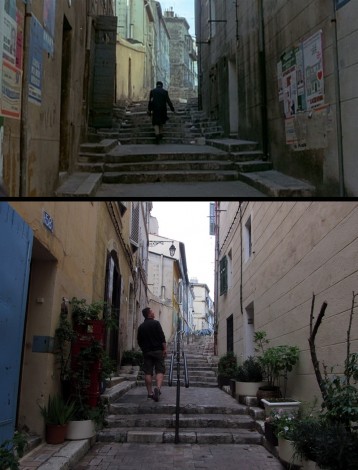
Friedkin shoots him from behind and then from in front, as he ascends the stepped walkway leading to his home—in the doorway of which someone else shoots him in the face before, rat-like, stealing a chunk of his baguette.
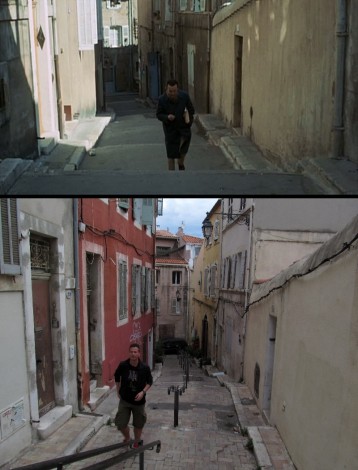
Following this street south, one comes to the steps found at the junction of Rue des Moulins and Montée des Accoules, where moments before in Friedkin’s film the same undercover cop is walking home.

As the film tells it, the route’s a white lie: there is no reason to be ascending the steps found at this junction as well as the steps found at that of Rue des Moulins and Rue du Panier in order to get to any of the properties in between. You approach Rue des Moulins by the north set of steps or by the south, but there’s no way of doing both. It’s possible that the agent was trying to shake off any potential tails, in which case he wasn’t very successful.
The French Connection also features the most hilariously ineffective onscreen tailing imaginable. Later in the film, Gene Hackman’s Popeye Doyle is ‘made’ by Charnier when he follows the latter onto a New York subway platform. Without any backup, Doyle must dance the tightrope between losing Charnier and being spotted by him. He shimmies accordingly, onto a train and off a train, onto another train and off again at the playful, cunning mercy of his quarry.
The irony is that while a foreigner somehow outwits NYPD cops and federal agents in the hustle and bustle of their own turf, a native in Marseilles seemingly doesn’t have the acumen to keep his cover. Then again, as evinced in the opening sequence, Marseilles is a much sleepier place than New York City and following just about anyone through its claustrophobic web without being noticed is nigh-on impossible.
Another contrast: Pierre Nicoli (Marcel Bozzuffi), Charnier’s henchman, has no trouble shooting a man at point blank range one afternoon (to hell with being heard!), but when he botches an assassination attempt on Doyle much later in the film by shooting a pram-pushing civilian by mistake, he goes from ruthless professional to implausibly inept idiot in a matter of seconds.
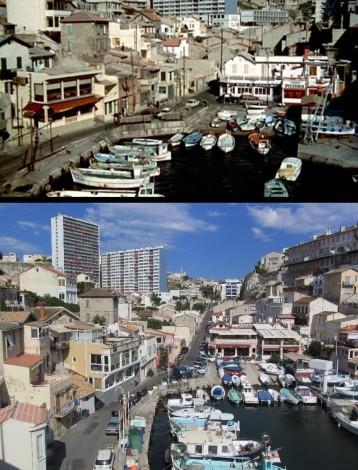
Friedkin’s film opens at Vallon des Auffes, a small port located three quarters of a mile along the main motorway from Fort Saint-Nicolas. On the way there, one passes the beach where, in French Connection II, Doyle interrupts a game of volleyball and seduces a bikini-clad woman by refusing to give her the ball back.
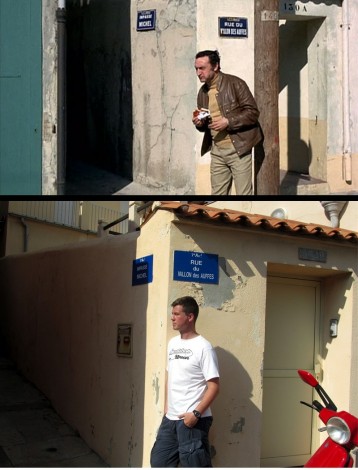
Vallon des Auffes is the location of both Chez Jeannot, the family-run pizzeria from which the undercover cop exits, and Chez Fonfon, the fancy bouillabaisse restaurant he spies Charnier leaving moments after. Both eateries are some distance from La Samaritaine, the popular corner brasserie and setting of the next scene, which is located at the northeast corner of the Old Port.
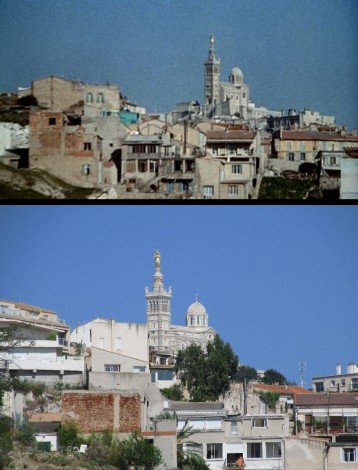
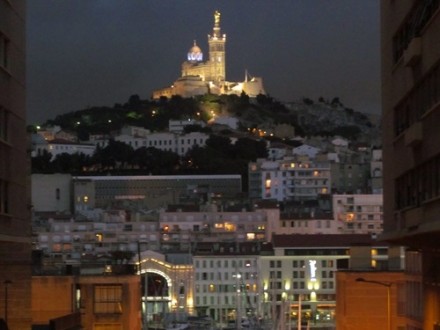
The film’s first shot, captured from the bridge that goes over Vallon des Auffes, is a zoom-out from the Notre-Dame de la Garde (‘Our Lady of the Guard’), the basilica that stands atop the 490-foot limestone outcrop on the south side of Marseilles’s Old Port. Notre-Dame de la Garde was designed by Henri-Jacques Espérandieu (1829-1874) and built between 1853 and 1864. Henri-Jacques Espérandieu was born in Nîmes, to the northwest of Marseilles. In addition to designing Notre-Dame de la Garde, he was with Léon Vaudoyer (1803-1872) a principal architect of Marseilles Cathedral, the Roman-Byzantine Catholic monument near Fort Saint-Jean.
Marseilles Cathedral was built between 1852 and 1896: though built on appreciably flatter terrain than Notre-Dame de la Garde, its erection began before and ended after the former’s completion dates. On 20 September the same year work began on the cathedral, the Lyons-born astronomer Jean Charcornac discovered the asteroid that is known today as 20 Massalia. Massalia was the Ancient Greek name for what became Marseilles. The first recorded permanent settlement in France was here, around 600 BCE. The day before Charcornac’s discovery, the same asteroid had been spotted independently, in Naples, by fellow astronomer Annibale de Gasparis.
On 15 August each year in Marseilles, cathedral and basilica are brought together by Assumption Day, on which the city’s Catholic population leads a ceremonial procession from the cathedral, carrying a golden statue of the Virgin Mary through the Old Town. The evening before sees an annual torch-lit procession up to the basilica. The 27-foot statue of the Madonna and Child that stands atop of the basilica is made of copper coated with gold leaf.
From the basilica—as well as, much closer to sea level, the coastal route that leads to Vallon des Auffes—one can see, glistening in the Mediterranean haze, the Château d’If, a fortress and former prison located on Île d’If. Île d’If is the smallest of four islands that make up the Frioul archipelago about two miles from land. The Château d’If was built as a military garrison between 1524 and 1531, though its defensive purposes were never actually called upon. Later, it was employed as a prison. On 30 November 1871 (a month shy of a century before The French Connection’s premiere), Gaston Crémieux, an important figure in the Paris Commune and leader of the correlative Marseilles Commune—was executed, following trial by military court, at the age of 35.
By 1871, of course, Île d’If had been made world-famous by Alexandre Dumas, whose 1844 novel The Count of Monte Cristo is set there. In the novel, the eponymous protagonist becomes the first man to escape the chateau as well as the island. By 1890, eleven years after Gaston Crémieux’s execution, the island had been demilitarised. On 23 September that year, it was opened to the public. In The French Connection, Charnier holds a clandestine meeting there with Henri Devereaux (Frédéric de Pasquale), the celebrity whose innocence he exploits in order to ship a large cargo of cocaine to New York City.
Michael Pattison
26th July, 2014
photographs by the author and Neil Young
further reading: Port Reports.