


IDEAS ABOVE THEIR STATION: Danilo Stanimirovic’s Prokop
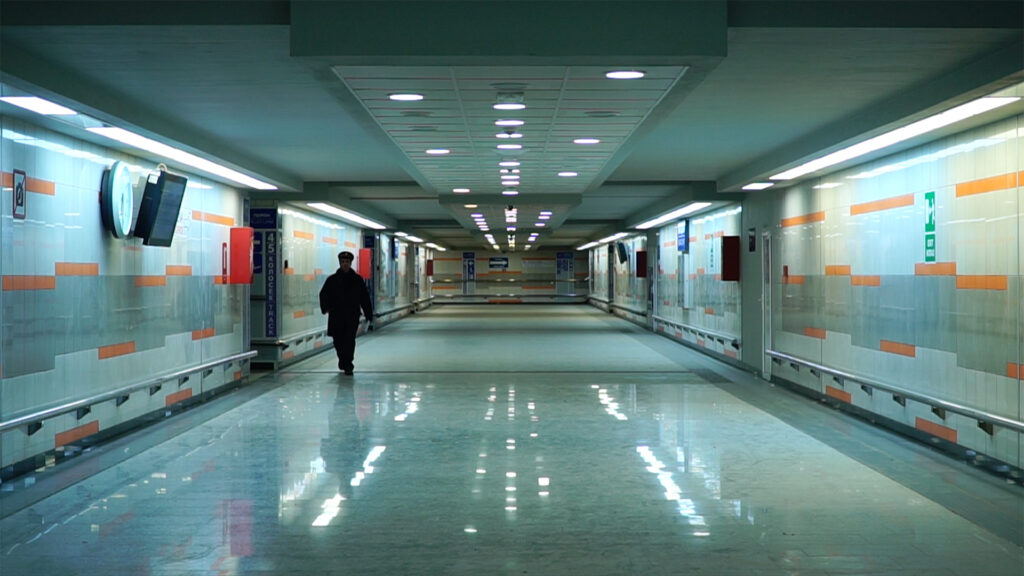
A curt and cutting little film about one of Europe’s most regrettable public-transport clusterfucks, Danilo Stanimirović’s Prokop runs a little under 12 minutes. This is nearly double the time it takes for a train to chug its way between Novi Beograd, the de facto main station of Serbia’s capital city Belgrade — located amid the sprawling modern suburbs on the north side of the river Sava — and its official public railway “hub,” Beograd Centar, a couple of crow-fly miles across the Sava in the neighbourhood of Prokop, whose name it officially shared until 2018.
To paraphrase Voltaire’s famous crack about Holy Roman Empire being neither holy, Roman nor an empire, “Belgrade Centre Station” is indeed in Belgrade, but central it is not and the appellation “station” is generous. Beograd Centar (BC) is, at present, little more than a glorified halt — a basic subterranean location where passengers can board or alight. Facilities are minimal to non-existent; at ground level, BC is astonishingly unimpressive: there is almost nothing to see; more elaborate station structures can be found in myriad small towns across the continent. (“Poor connection with the city, the white train does not go so often, the directions to the city are poorly marked, if you need a certain station there is no information or map how to get there, which direction, for the 21st century in English, this station is horror,” as opined a Google reviewer in March 2021.)
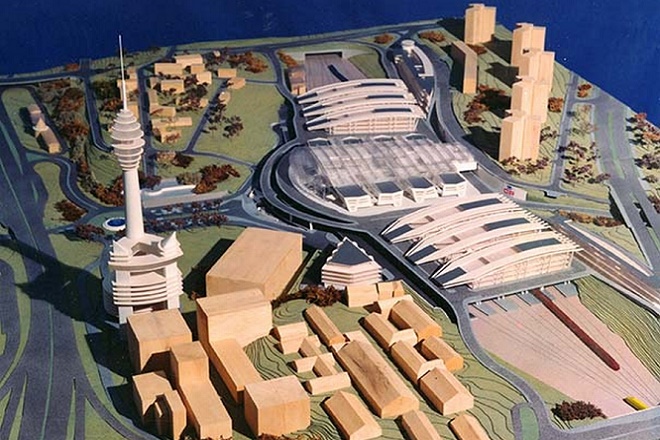
As Stanimirović’s closing texts dryly observe, “In July 2018, with the closure of the Main Railway Station in the city center [sic], Belgrade became the only capital whose railway station does not have a station building.” Such a building is officially on its way, and Prokop concludes by dissolving a superimposition of an artist’s impression of uninspired, functional glass-and-steel blocks on top of the real-life vista. But anyone who has followed this project over the five frustrating decades of its planning and piecemeal execution — as glimpsed via period photographs here, and as exhaustively and world-wearily (and, it must be said, entertainingly) chronicled on the station’s Wikipedia page — will be forgiven for not holding their breath.
Stanimirović’s calmly ruminative short is more of an artistic contemplation of a shameful — and financially scandalous — public-engineering catastrophe than a campaigning attempt to bring the matter to international attention. Cinematographer Aleksa Borković surveys the scene, his stately images of the ghostly station finding unlikely poetry in reflective surfaces, geometric constructions and occasional, fleeting work-in-progress tableaux. Nikola Kostović’s sound-design likewise includes distant hammering but generally emphasises the eerie, incongruous depopulation of the place: “grand central station” this most certainly is not. The editing by the director and Mina Petrović maintains an even pace with takes of a few seconds apiece, juxtaposing new footage with images of the station and its environs over a half-century of painfully halting “progress.” As anyone who has spent much time in Serbia knows, one of the most important words in its language is polako…. “slowly.”
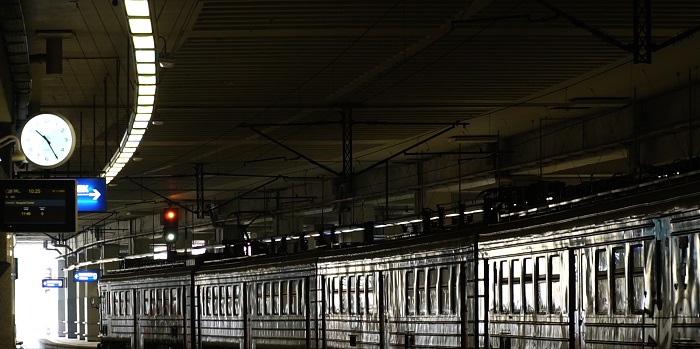
Premiering at Belgrade’s leading non-fiction-oriented film showcase Beldocs in September 2021, Prokop will likely find further play at similarly discerning shorts festivals and events focused on architectural matters. The chances of it being seen, let alone acted upon, by anyone within or cyearyearonnected to the Serbian ministries responsible for the central station fiasco are sadly minimal. As an indictment of the gangsterish, corruption-ridden government of president Aleksandar Vučić — which, like all nearly all right-wing neo-liberal parties around the world, is nakedly hostile to public transport in general and railways* in particular — the film is at best an elegantly buzzing mosquito pecking at the hide of a complacent, ideologically-blinkered and strictly short-term-focussed pachyderm.
This particular catalogue of inefficiency, profligacy, atrocious mismanagement and deathly slow foot-dragging has been going on for so long, however, that blame can and should be apportioned across multiple regimes — stretching back to Serbia’s pre-1990s period as the biggest and most powerful element in the Yugoslavian Federation of Socialist Republics. (“It is as if everything has simply been left to degrade for a couple of decades,” as Jon Worth said about the Serbian railway “network.”)
The “main railway station” which closed in 2018 (it is now a museum) and which was completed in 1885, was always a somewhat functional and unspectacular affair, something of a shoebox compared with the cavernously grand, architecturally glorious termini to be found in Milan, Helsinki, Budapest or Leipzig. It was rather dinky and homely for any major European city — let alone during the heyday of Yugoslavia when the city was capital of a strategically important country with 22 million inhabitants. But the old building was certainly not without charm, even in its final months of winding-down activity: a small bar served bottles of beer to ageing male patrons (few of whom had trains to catch), the underlit 1960s-style ticket booths allowed prospective passengers to tangle with gruffly tetchy female staff, a currency exchange-office near the main exit offered dinars at reasonable rates.
And the biscuit-coloured edifice was at least located in a very handy spot, right next to the main bus station (a scruffy remnant of the 1970s which the government is [of course] threatening to relocate to Novi Beograd next year) and convenient for the city’s bustling tram network. The old station’s prime location, sadly, led directly to its demise: it was much too close to the glitzy and gargantuan Belgrade Waterfront development, dubbed “Dubai on the Danube” and widely regarded locally as little more than elaborate front for money-laundering. The flogging of overpriced high-rise apartments was made that bit easier by the removal of a busy railway line which ran only metres away from their front doors, never mind the resulting inconvenience to ordinary Belgraders.
Beograd Centar, by contrast, is handy only for those visiting the immediate area. It is walking distance from the upmarket suburb of Dedinje — where the mausoleum of Yugoslavia’s longtime leader Tito is located in the House of Flowers, adjoining the Museum of Yugoslavia — and, just beyond. the stadiums of the city’s two deadly-rival football teams, Red Star and Partizan.
As the Wikipedia entry notes, the public transport connections of “Prokop” — as the station is still dubbed by nearly everyone who uses it — are ludicrously limited: just one bus every 40 minutes. This is main one of the reasons why Novi Beograd, which is comparatively well served by buses and trams (and is also easier for private cars to access for pick-up purposes) has become the de facto terminus for the city. Prokop, meanwhile, remains something of a miniature white elephant, of laughably little use a transport hub but inadvertently useful as arguably the perfect three-dimensional encapsulation of how not to run public services in the 21st century.
Neil Young
11th October, 2021
* POSTSCRIPT
After my spell on the shorts jury at BelDocs I continued my stay in Serbia, travelling by bus from Belgrade to the country’s second biggest city Novi Sad. I had to do this by bus, as the train line between Belgrade and Novi Sad (just 53 miles across the near pan-flat terrain of Vojvodina) has been in a state of “upgrading” since 2019; this is projected to be completed in 2022 (polako, polako…).
I did, however, proceed by train from Novi Sad to Sombor, an historic small city also in Vojvodina, 50 miles away, best known now as home-town of NBA superstar Nikola Jokić. When I told my hosts (artistically-active socialists) in Novi Sad about this plan they — and a local-resident acquaintance, who happened to be in the room at the time — expressed concern and surprise that such a train even existed. I assured them that I had checked this in the train station on my arrival at Novi Sad’s bus station (right next door). “Ah, but the train will be replaced by a bus….. And if the train does somehow operate, it will be very dirty, it will arrive late here and encounter long delays on the way to Sombor. Better to just take the bus!”
Such dire prognostications proved inaccurate: the train came on time, was reasonably clean, and arrived in Sombor exactly as scheduled. Thus do governments like Serbia’s get away with underfunding railways. A vicious circle is easily created: the train system gets such a bad public reputation that people instinctively seek alternative methods of getting around, resulting in falling passenger numbers, resulting in reduced government funding, resulting in declining railway standards, and so on to motorway-dominated oblivion.