

Xavier Beauvois’ OF GODS AND MEN [6/10]
But at the centre of his own faith there always stood the convincing mystery — that we were made in God’s image. … Something resembling God dangled from the gibbet or went into odd attitudes before the bullets in a prison yard or contorted itself like a camel in the attitude of sex. He would sit in the confessional and hear the complicated dirty ingenuities which God’s image had thought out, and God’s image shook now, up and down on the mule’s back, with the yellow teeth sticking out over the lower lip, and God’s image did its despairing act of rebellion with Maria in the hut among the rats. He said, ‘Do you feel better now? Not so cold, eh? Or so hot?’ and pressed his hand with a kind of driven tenderness upon the shoulders of God’s image.
—–
Graham Greene, The Power and the Glory, p101
—– —–
Quietly absorbing true story of how a community of French monks found themselves fatally enmeshed in a north African conflict during the mid-1990s. As the gravity of their situation intensifies, the beekeeping, mainly elderly brothers – led by the softly-spoken Christian (Lambert Wilson) – consider fleeing to safety back home in France. But, concerned for the safety of the villagers who live in the environs of their long-established institution – upon which the locals rely for medical treatment – they eventually elect to remain and face the consequences, on the basis that “the good shepherd doesn’t abandon his sheep to the wolves.”
The result is a solid, dutiful, “well-made” and impeccably-intentioned affair – and such competently-handled treatments of such serious, tragic subjects invariably attract their share of praise and awards. Directed and co-written by Xavier Beauvois (with Etienne Comar), Of Gods and Men duly won the (runner-up) Grand Jury Prize at the Cannes Film Festival – even though it is, formally and stylistically, somewhat conventional and conservative.
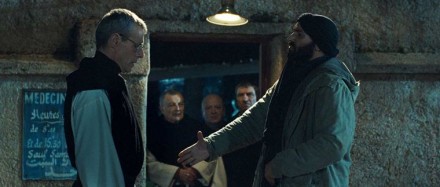
The fact that the film examines a tricky interface between Christianity and Islam, meanwhile, provides an ever-topical edge – and while Beauvois and Comar’s screenplay shows appropriate respect to both “sides”, the concentration on the monks necessarily sidelines Islamic voices. Indeed, by some way the strongest scene – in which Islamist rebels storm the monastery by force on the night of Christmas Eve seeking medical supplies – is the one which most effectively gives equal prominence to both faiths, Christian eventually reaching an understanding with fearsome guerrila-chief Ali Fayattia (Farid Larbi).
The rebels’ aims and philosophy remain somewhat vague, however: Beauvois and Comar wisely resist the temptation to come up with speculative answers to the still-mysterious circumstances of the monks’ final hours, but the film is frustratingly fuzzy on specifics throughout. Even the country where the action takes place remains scrupulously unidentified – though we can deduce, partly via the lingering resentment of a government official (who blames “French colonialisation” for his nation’s ongoing strifes), partly from the name of the monastery (Monastère de l’Atlas) that it’s most likely Algeria.
Beauvois and Comar are more preoccupied with the characters and viewpoints of the monks themselves – initially an octet, joined by a ninth man near the end – among whom Lambert, plus octogenarian Jacques Herlin (twinkly-eyed, gnome-like ancient Amédée), Olivier Rabourdin (Christophe, one of the group’s younger and more spiritually troubled members) and Michel Lonsdale (stoic, self-effacing medic Luc) stand out.
Pauline Kael once remarked that some might find Robert Bresson’s Au hasard, Balthazar “offensively holy,” and there’s certainly a risk of that with Of Gods and Men – its only surprising and unpredictable element concerning the fate of two monks, as revealed via closing captions. Otherwise this is a reverent, slightly plodding exploration of faith and grace in a decidedly extremis situation – but while admirably grave, complex themes are discussed and dramatised, they never quite fully come to life.
The film’s theological/philosophical debates on the nature of martyrdom are more engagingly presented in T S Eliot’s play Murder in the Cathedral, while the solemn depiction of monastic ritual is much closer to Philip Gröning ‘s 2005 documentary Into Great Silence than, say, Powell & Pressburger’s Black Narcissus – the latter, 60-odd years later, still the most persuasive and pungent examination of how cloistered communities, (especially those comprising “foreigners” far from home) can be tested to the point of near-destruction by external disruption and internal fractures.
Neil Young
17th December, 2010
OF GODS AND MEN
[6/10] : Des Hommes et des dieux : France 2010 : Xavier BEAUVOIS : 122m
seen 14/Dec/10 at The Tyneside Cinema, Newcastle : (£3.75) : {16/28}