Joost & Schulman’s ‘Catfish’ [7/10]
Good documentaries should make you question, rather than slavishly accept, their veracity. (Critics seem deeply confused about this issue.)
Errol Morris (via Twitter), 27th December 2010
—————————————
In the eight-or-so decades since Robert Flaherty “cast” an inuit named Allakariallak to “play” the title-role in his “documentary” Nanook of the North (1922), one of the most contentious – and, it must be said, tiresome – debates in cinema has involved the extent to which non-fiction films contain fictional elements (and vice versa). Werner Herzog for one never misses a chance to expound his philosophy about there being no distinction between documentary and fiction cinema, while in the wake of The Blair Witch Project (1999) and its many imitators audiences have become increasingly savvy – and blasé – about the faux-doc sub-genre. All of which makes debutant directors Henry Joost and Ariel Schulman’s achievement with Catfish all the more noteworthy and admirable.
Because, nearly a year after Catfish premiered at the Sundance Film Festival, nobody – apart from the film-makers themselves – knows for sure whether or not the whole thing is a straightforward fly-on-the-wall affair, a skilful fabrication, or some hybrid of the two. One tantalising possibility is that the movie is a “real” documentary, but one which has been very cleverly tweaked to give off faux vibes – with the intention of leaving audiences pleasingly baffled, and willing/anxious to watch it again in search of further “clues.” Can it really be a coincidence, for example, that a key aspect of the “plot” so closely mirrors that of one acclaimed documentary from the past decade, Amir Bar-Lev’s My Kid Could Paint That (2008), while the idea of documentarians accidentally and serendipitously stumbling across dynamite material echoes what happened with Andrew Jarecki (one of Catfish‘s producers, no less) on Capturing the Friedmans (2003) – which started off as a profile of a professional party clown, and ended up being a jaw-dropping examination of paedophile hysteria.
The “story” of Catfish is a complicated one, but it starts off as the record of a long-distance friendship – and artistic collaboration – between a New York based photographer, Yaniv “Niv” Schulman (brother of co-director Ariel) and Abby, a seven-year-old girl in a remote mid-western town who seems to have prodigious skills as a painter. She mails Yaniv examples of her artwork – versions of his own published photographs. The two communicate via the preferred medium of so many young people across the world these days, via Facebook – which brings Yaniv into contact with Abby’s half-sister Megan Faccio. Yaniv and Megan strike up an e-relationship which involves steamy texts and telephone calls, but no face-to-face meetings. Again, not so unusual in these early years of the 21st century. All goes swimmingly – until Yaniv starts to suspect that Megan isn’t the singer/songwriter virtuouso she claims to be. Accompanied by Ariel and the latter’s collaborator Henry Joost, Yaniv decides to pay a “surprise” visit to Abby, Megan and their family…
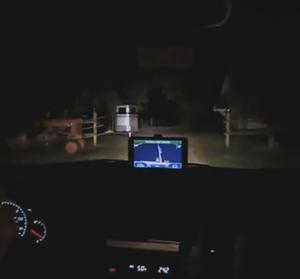
It’s at this stage – roughly halfway through the running-time – that Catfish really gets going, though to say any more would be to ruin the effect of a picture which depends upon the steady parcelling-out of information, with the viewer knowing no more or less than Yaniv at each stage of his engagement with Abby and Megan (even the explanation of the picture’s title would constitute an unfair “spoiler”.) Unpredictability is key: there’s genuine tension in an extended sequence when the Schulmans drive out to Megan’s farm in the middle of the night – a real sense that events might well take a turn into the supernatural and/or horrific.
It isn’t giving too much away to say that such developments don’t actually occur, though their discoveries do include a certain amount of disturbing psychological material involving Abby and Megan’s mother – a certain Angela Wesselman who, if she is some kind of actress hired by Schulman and Joost to play a role, contributes eminently award-worthy “work.”
No doubt, before too long, the real status of Catfish will become a matter of public knowledge and record – but in a way, such definitive answers are irrelevant – within its own parameters, and on its own terms, the movie emphatically works, saying considerably more about inter-personal relationships and communications in the 21st century than David Fincher’s considerably longer, considerably more ballyhooed and critically-lauded The Social Network.
Neil Young
27th December, 2010
CATFISH
[7/10] : USA 2010 : Henry JOOST & Ariel SCHULMAN : 84m
seen 19/Dec/10 at The Tyneside Cinema, Newcastle : (£7.50) : {20/28}
original rating: 18/28