


for TRIBUNE 9.Dec : ‘Unmade Beds’ [6/10], Ljubljana film-festival report
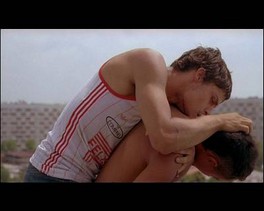
Unmade Beds
Director: Alexis Dos Santos
Regular readers of this column will know that one of our recurring gripes concerns the vagaries of UK distribution, specifically when it comes to "arthouse" releases. Sometimes there are specific, practical reasons why pictures that glean widespread acclaim and awards never make it into British movie-houses – such as Argentinian writer-director Alexis Dos Santos's debut Glue.
Aptly subtitled A Teenage Story in the Middle of Nowhere, this atmospheric, hormonally-charged and autobiographical chronicle of three teenage friends in small-town Patagonia picked up jury-prizes and warm notices from influential publications back in 2006. But it has yet to be commercially released outside Holland, Austria and Germany, allegedly because of a wrangle involving the unauthorised (but excellent) use of soundtrack music, including the Violent Femmes classic 'Blister in the Sun'.
Three years later, we have Dos Santos's followup – co-written with Marianela Maldonado – which is another (hormonally-charged) look at contemporary young folk. Once again, his integration of music is top-notch (including the audacious gambit of occasionally playing the same songs twice), but this time the action is very much in the middle of somewhere: swinging late-noughties London to be precise, although most locations are convincingly doubled by Nottingham, of all places.
Here in NG1 – sorry, NW1 – we encounter some photogenically dishevelled and tousle-haired sorts such as Axel (Fernando Tielve) and Vera (Deborah Francois), a pair of cash-strapped continentals in their early twenties – he Spanish, she Belgian – who have arrived in the capital, one presumes, largely thanks to the wonders of budget airlines. The rise of Stansted as the key European transportation hub over the past decade has coincideded with the emergence of an internet-savvy generation for whom English is a taken-for-granted lingua franca, and for whom, post-1992, post-Schengen, borders are so very last century.
Unmade Beds is one of the first pictures to surf this particular aspect of the zeitgeist, depicting a multi-cultural demi-monde of bars, clubs, easy-come-easy-go squats, haphazard sexual experimentation, post-modern hipsterism and assymetrical haircuts. And whereas Jean-Luc Godard famously spoke of the 1960s' "children of Marx and Coca-Cola", this ragtag, apolitical shower are more like the offspring of Pete Doherty and WKD.
Now 35, Dos Santos may be a shade (or two) older than his protagonists, but he's very much "down with the kids," employing a crew that's a freshly ecletic as his intercontinental cast: Swedish cinematographer Jakob Ihre and Danish editor Olivier Bugge Coutte previously collaborated on Joachim Trier's Reprise (2006), a rather more austere and probing journey into the lives of affluent, discontented contempo-Euro youth. Unmade Beds is, as its title indicates, a shaggier, looser enterprise, shot on nicely grainy celluloid and with a smudgy waywardness that unfussily mirrors its characters' fumblings towards personal and sexual fulfilment.
For most of the running-time Axel and Vera navigate London's funky byways solo – it's only quite late on that their paths and stories converge, when Dos Santos and Maldonado feel the need to engage with that bothersome business called "plot" – Axel is apparently in town to track down his long-lost dad. By this point the film may have cast an unassuming spell over indulgent audiences – though anyone closer to, say, Dos Santos's age than that of his creations may well decide that it's amiable but disposably noodling fluff.
——————————————————————————
 HERZOG DEEP, MOUNTAIN HIGH
Report from the 20th Ljubljana International Film Festival
ON balance, it was a good week to be in Slovenia. True, I arrived in the capital of this most northerly and wealthiest ex-Yugoslav republic – the first and so far only one to join the EU – on the day that the British newspapers carried extensive obituaries for local hero Tomaž Humar, a 40-year-old mountaineer and author (of local bestseller No Impossible Ways) whose body had just been found in a remote Himalayan region. But the mourning soon gave way to wild jubilation, and before dawn this small nation had a new hero to cheer.
This was Zlatko Dedič, the footballer whose crucial goal in the play-off match (in second-city Maribor) that very evening ensured that little Slovenia denied the mighty Russia and this landed a slot in next summer's World Cup. I passed by the crowds noisily celebrating the upset victory outside the post office just after midnight, fancied that I glimpsed the shade of Yugoslavia's USSR-baiting leader Tito among the throngs, gesturing rudely in the direction of Moscow as he swigged from a bottle of his beloved J+B.
I DID toy with watching the match myself in one of the city-centre bars, but my sense of responsibility as a film critic propelled me instead to the one-screen, gloriously old-school Kinoklub Vič (pronounced "Veech") to catch Werner Herzog's The Bad Lieutenant – Port of Call : New Orleans, which injudiciously coincided with the Maribor second half.
Fortunately, the picture provided just as much entertainment and unlikely drama as the match itself. An in-name-only remake of Abel Ferrara's 1992 cult favourite Bad Lieutenant (it has at least as much to do with James Toback's 1974 Dostoyevsky adaptation The Gambler), Herzog's berserk policier stars an increasingly unbridled Nicolas Cage as Terence McDonagh, a corrupt, backache-plagued, drug-addicted cop in an atmospheric, semi-flooded city still recovering from the ravages of Hurricane Katrina.
Cage's prolific work-rate over the past few years is reportedly due a colossal tax demand – he's had to sell a German castle which he owned (as you do), and was recently seen switching the Christmas lights on in Bath (ditto), which happens to be close to another of his residences.
But his semi-accidental collaboration with legendary German auteur Herzog – responsible for such classics as Aguirre, the Wrath of God (1972), Heart of Glass (1976), Fitzcarraldo (1982), Nosferatu (1979) and The Enigma of Kaspar Hauser (1974), among many others – represents cine-serendipity of the very highest order.
Herzog, now 67, has enjoyed a welcome career-revival over the past couple of years, with the likes of Grizzly Man (2005), Rescue Dawn (2006) and the Oscar-nominated documentary Encounters at the End of the World (2007). This brought the long-time Los Angeles resident to the attention of some adventurous producers, and thus he was signed up to bring scriptwriter William M Finkelstein's Bad Lieutenant remake to the screen.
The result is something entirely rich and strange, and which works on multiple levels. It is entirely possible to regard the picture – which co-stars Val Kilmer, rapper Xzibit (who's surprisingly good) and Eva Mendes – as a pretty "straight" (as in straight-to-video) thriller with weird trimmings. Indeed, many of the Ljubljana audience seemed to take it at face value, paying rapt attention with stony faces.
Not wanting to disturb their viewing, at certain junctures I found myself crying into my handkerchief with suppressed laughter at Herzog and Cage's baroque excesses – bizarre visions and behaviour which lift The Bad Lieutenant into the realm of the genuinely satirical and subversive in its depiction of contemporary American "success."
And Cage's isn't even, strictly speaking, the oddest performance in the film – that honour goes to Shea Whigham as cocky, ever-so-smooth-talking no-goodnik Justin (breathy catch-phrase "ohh yeahhhh"), whose handful of scenes with McDonagh recall the legendary ham-vs-ham squareoffs between Dennis Hopper and Crispin Glover in River's Edge.
Just as the Lt McDonagh sees his cop-badge as a license to disobey society's conventions, Herzog likewise uses the anti-hero's drug intake – some of it medicinal, most of it recreational – as an excuse to go down all manner of unexpected avenues, in terms of tone, visuals, plot and characterisation.
Both risk disaster at numerous junctures; both somehow extract a kind of glory from potential career-ending catastrophe. The result takes the extremely hackneyed "maverick cop" template and pushes it into the realms of the truly berserk. One hopes to see it in every British multiplex sooner rather than later.
ALSO keep an eye out for Cheang Pou-Soi's Accident (Yi ngoi), produced by Hong Kong's reigning action-thriller king Johnnie To. An ingenious and cerebral affair already slated for a Hollywood remake, it chronicles the murderous exploits of an assassination bureau whose "hits" are designed to look like random-chance occurrences.
But the leader of the pack – a cool, analytical chap aptly nicknamed Brain (Louis Koo) – starts to suspect that his outfit is being targeted by an even more skilful team operating along similar lines, tipping him (all too) quickly into a jangly paranoia that's not-so-coincidentally reminiscent of Harry Caul in Francis Ford Coppola's The Conversation (1974).
After a gangbusters opening and an intriguing first act, Accident seems to lose its way somewhat in the more gently-paced middle-section, during which veteran director Cheang and scriptwriters Szeto Kam-Yuen and Tang Lik-Kei seem to take their eye off the ball in terms of narrative development.
The slog through this soggy patch proves very much worthwhile, however, in a satisfyingly emotional, savagely ironic finale which lays bare the limits and pitfalls of over-intellectualism (and excessive cynicism) in – ironically, enough – decidedly "brainy" fashion.
I ONLY caught one other feature during my five days in Ljubljana: Danish writer-director Nicolas Winding Refn's Valhalla Rising. A speedy, change-of-gears follow-up to his engagingly Ken Russell-like true-crime biopic Bronson from last year, this is a ponderous viking-era mini-epic set in the wilds of medieval Scotland, in which a one-eyed, battle-brutalised, mute Nordic warrior (Mads Mikkelsen) seeks a return to his long-forsaken homeland.
A promisingly violent, mud-splattered, bone-crunching first reel quickly gives way to protracted, pretentious, nebulous sequences – reminiscent of Lars Von Trier at his most mannered – which see Refn unwisely groping towards spiritual and psychological significance.
Morten Søborg's cinematography is consistently striking, but problems really kick in when 'One Eye' and his Scots chums set off on a sea-voyage, only to be becalmed for what seems like an eternity. The becalming of a ship has long been a particularly tricky business to depict on celluloid, as it's so easy for the audience to share the torpid ennui that envelops the characters.
Let's just say that Refn has no more success than, say, Andrzej Wajda in his 1976 Joseph Conrad adaptation The Shadow-Line, and after this extended sequence of inactivity Valhalla Rising only really makes sense in the most oblique, fable-like terms.
Refn, of course, would never claim to be a Wajda. Previously responsible for the Pusher trilogy, he's long been one of Denmark's more unapologetically commercially-minded directors – which makes this picturesquely elemental wrong-turn into leaden mysticism all the more head-scratching.
MY relative paucity of full-length screenings in Ljubljana is partly due to the fact that I am a member of the festival's programming board (so I had seen many of the best features already), a role that disbars me from commenting on the event in general. And it was also related to my time-consuming duties on the short-film jury – which involved watching 15 works ably selected by Martin Marzidovšek.
Pick of the bunch for me was Arena by Portugal's 25-year-old João Salaviza, a 15-minute essay on borderline-criminal masculinity and dysfunctionally grand modern architecture that plays like a taut, steroidal condensation of Matteo Garrone's much-ballyhooed Mafia epic Gomorra. Though winner of the Palme d'Or in Cannes, Arena cut surprisingly little ice with my two fellow jurors, and our consensus pick was Jochem De Vries' Dutch miniature Missing (Missen), a delicate and nicely uninflected tale of a dysfunctional mother and her precocious child.
Among the other candidates, a name to watch is Hungary's Esztergályos Krisztina, whose 28-minute Variations (Variációk) is as formally ambitious as it is trite content-wise – while Sweden's Andreas Tibblin, with Good Advice (Goda Råd), and Bulgaria's Dragomir Sholev, with the audaciously-titled The Go-Between (Posrednik), also figured strongly in my calculations.
Neil Young
1st-13th December, 2009
based on articles written for the 9th December issue of Tribune magazine

UNMADE BEDS : [6/10] : UK 2009 : Alexis DOS SANTOS : 97m (BBFC) : seen 28th January, Schouwburg theatre, Rotterdam (public show – paid ‚¬9) International Film Festival Rotterdam. [16/28]
THE BAD LIEUTENANT – PORT OF CALL : NEW ORLEANS : [8/10] : USA 2009 : Werner HERZOG : 121m : seen 18th November, Kino Vic : [21/28]
VALHALLA RISING : [5/10] : UK/Denmark 2009 : Nicolas Winding REFN : 90m approx : [12/28] : seen 20th November, KinoDvor
ACCIDENT : [7/10] : Yi ngoi : Hong Kong (China) 2009 : Cheang Pou-Soi : 89m : [19/28] : seen 21st November, Cankarjev Dom
— above three all seen in Ljubljana at Ljubljana International Film Festival - public shows (complimentary tickets)
Jigsaw Lounge Ljubljana 2009 ratings page