


Confessions of a Barge-Hand, or, Messiah of Alienation: David Mackenzie’s YOUNG ADAM
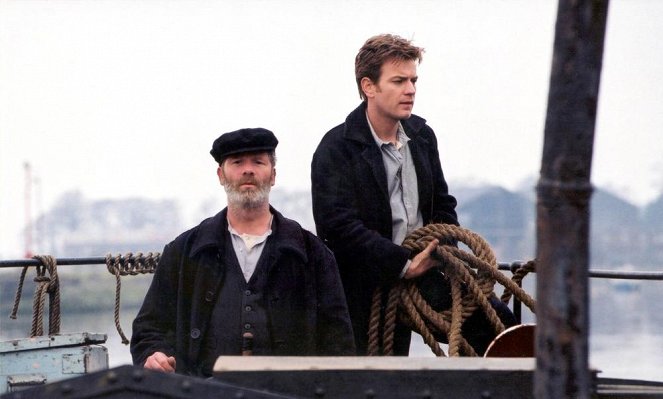
Last August, Lynne Ramsay’s Morvern Callar opened the Edinburgh Film Festival amid much Cannes-fuelled ballyhoo telling us how it was going to be the big British movie of 2002. And despite the film’s eventual fate as a box-office bomb, the hoopla was at least semi-justified: until running inexplicably (and abruptly) out of gas two-thirds through, Ramsay’s second film (after Ratcatcher) had shown enough to suggest she’s one of the very few current UK directors anywhere near world class.
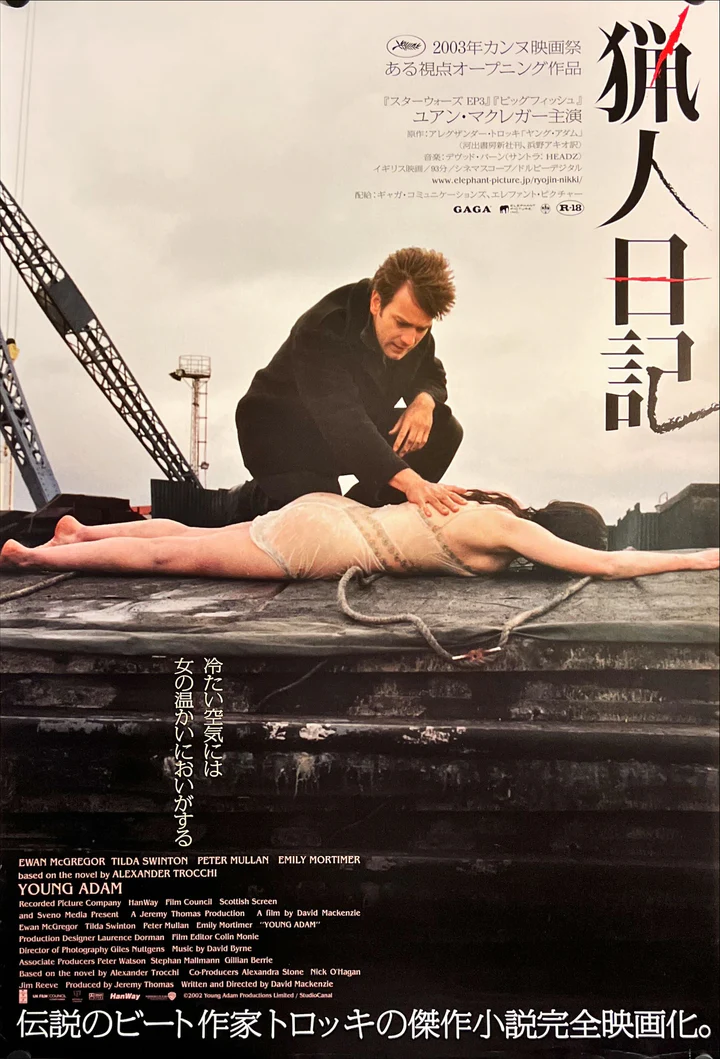
Edinburgh ’02 also — and much more quietly — showcased another Scottish ‘contender’ in David Mackenzie, whose The Last Great Wilderness world-premiered in the UK Gala section. But the hype for his second film had already begun: “Mackenzie [is] currently working on his next feature,” confided the festival brochure, “the highly-anticipated Young Adam, with Ewan McGregor and Tilda Swinton,” based on the 1954 novel by Alexander Trocchi.
Twelve months on, Edinburgh ’03 kicks off with the very same Young Adam — which, just like Morvern Callar before it, attracted very favourable attention in its out-of-competition world-premiere at Cannes. At the same time, The Last Great Wilderness was reaping broadly positive notices during its limited UK arthouse release, many critics noting that Mackenzie’s talent would be confirmed by his impending ‘bigger’ followup. If nothing else, Young Adam looks certain to comfortably outdistance both Morvern Callar and The Last Great Wilderness at the box office, if only because (A) it’s got McGregor in it and (B) it features more on-screen sex than any non-porn, non-Japanese release of this or most other years.
In fact, ‘Confessions of a Barge-hand’ would have been a more accurate title for the movie, if Mackenzie and co weren ’t so clearly aiming for much more high-toned fare than the infamous 1970s series of naughty ‘Confessions ’ movies starring cheeky Robin Askwith: in the press notes, the director loftily describes Joe as “the messiah of alienation.”
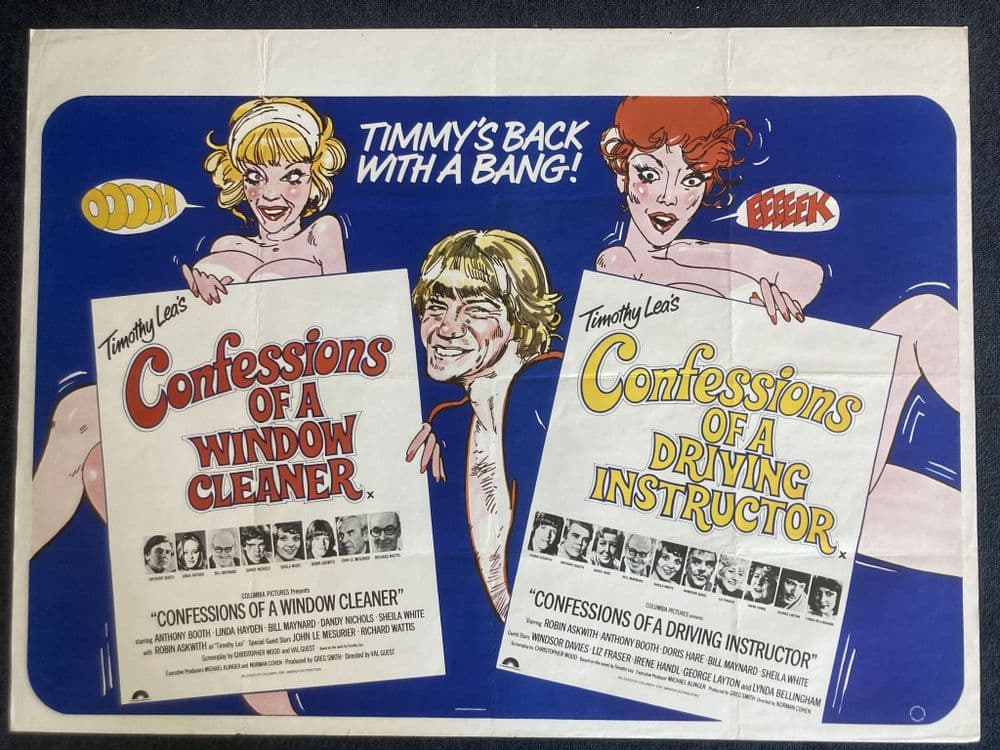
It’s becomes increasingly hard (!!!) to suppress heretical memories of Askwith’s priapic Confessions hero, however, as Joe proceeds to screw every adult female character in the movie who has a speaking part — Mackenzie also implies that none of Joe’s fellow Glaswegian males is capable of ‘performance’ (a psychological and/or physiological consequence of their involvement in World War II?). These include Jim Gault (Peter Mullan), who owns the barge on which Joe lives and works; among the younger man’s conquests are Jim’s unsatisfied wife Ella (Swinton), and also, in flashback, a young woman named Cathie (Emily Mortimer). The plot, such as it is, begins when Les spots the semi-naked body of a young woman floating in the Clyde, later identified as Cathie — but what role, if any, did Joe play in her demise?
Though he toys with the film noir, Postman Always Rings Twice / Double Indemnity-ish aspects of Young Adam‘s central love-triangle (interiors are generally shadowy, candle-lit, darkened with coal-dust), Mackenzie isn’t really interested in suspense, tension or the crafting of a thriller — much less a whodunnit — given that the circumstances of Cathie’s death are revealed shortly after halfway. Instead, this is a rather gloomy, downbeat character study of Joe — a wannabe writer with an anachronistic hairstyle and an implausibly watered-down Scottish accent who doesn’t, unfortunately, seem to possess much in the way of literary ability (unless we’re supposed to regard the film itself as an adaptation of the novel which Joe/Trocchi will later write).
Instead, Joe expresses himself in the most natural and direct way he knows — sex. Sex is also a means for Joe to exorcise whatever guilt he feels about Cathie, and the other people he has harmed (indirectly or directly, deliberately or accidentally) as he makes his egotistical, solipsistic way through life. The remarkable amount of copulation is, then, fully justified: if nothing else, Mackenzie illustrates just how reticent British directors have been about tackling this key subject, especially compared with, say, France or Japan, which both have long traditions of taboo-busting ‘sensual’ cinema.
But the relentlessness of Joe’s sexual expression will undoubtedly cause a bemused stir among many UK observers — especially as McGregor, thanks to films such as The Pillow Book, has long been famed in the tabloids for ‘getting his kit off’ at every opportunity on screen. Young Adam deserves to be taken much more seriously than just ‘another Ewan McGregor shag-a-thon,’ however. This is a measured, engaging mood-piece of a movie, bold in its pursuit of character above action but never less than accessible to general audiences.
What it decidedly isn’t, however, is a step forward from The Last Great Wilderness. That picture, while deeply flawed, at least had an energy and originality which finds no place in Young Adam — the directorial ‘progression’ is all too reminiscent of Christopher Nolan making his name with the dazzzling Memento, only to deliberately change down several gears for the much more orthodox Insomnia, where his primary motivation seemed to be a desire to convince Hollywood he could be trusted with big names and a big budget.
Young Adam pushes boundaries in one area and one area only — sex. Solidly performed and patiently handled (occasionally too patiently; Mackenzie’s careful approach occasionally slows down into paceless ponderousness), in terms of directorial style, the film wouldn’t have seemed especially innovative back when it’s set, in 1953. In the end, Young Adam shares much with its principal setting: like the Gault’s barge, the film may lack oomph, even if does get reach its destination eventually. But it is, for all its pleasures, a decidedly old-fashioned mode of transport fifty years on.
Neil Young
3rd August, 2003
(seen 6th June: Showcase, Dudley)
For the original short review click here.
–