


Sheila Seacroft’s Cluj-2011 Dispatches (1) REENACTMENT, etc

UP-TOWN TOP-RANKING
Each year the Transilvania Film Festival, and in parallel the city of Cluj, gets bigger and more swanky. After missing last year’s festival this was for me more in evidence than ever. Now using eight indoor and two alfresco screens, with films from 10 in the morning till after 1 am, and now in its tenth year, it’s not surprising that earlier this year TIFF gained accreditation from the International Federation of Film Producers Association, putting it into the top rank of festivals.
Here big is indeed beautiful, but small remains beautiful too, the festival organisation has still a very light and personal touch, combining the friendly and informal with tremendous efficiency. And lots of those things I love Cluj for haven’t changed: the permanent bustle of the streets, the smells of strawberries and dill and the heaped cherries in the food market, the Roma girls selling handfuls of hand-carved spoons and squares of silk, the old ladies with their home-preserved honey in the market and bunches of garden flowers at street corners, the fussy, scruffy little winding streets with their glimpses of domestic courtyards and gardens, that will open out into boulevards or elegant squares, the open doors of the crammed Orthodox churches on a Sunday morning the jaunty lit-up sign of the Melody Hotel, a survivor from grimmer days, the trams and trolley buses, the green river that swells so quickly with the storms, and around it all the circle of hills topped with forests and dotted with sheep.
There are new smart things too – a second out-of-town shopping mall, fountains and more paved areas to sit and wander in. The old Republica Cinema, communist-concrete, increasingly shabby and two years ago under threat of demolition, has despite everything survived and was reopened earlier this year as the Cinema Florin Piersic, beautifully refurbished, comfortable; but a serious quibble is the white interior walls, which mean it is never quite dark enough. The old favourite cinemas are stlll there, the Arta and the Victoria, havens of darkness and often filled to bursting, and this year the festival has really taken itself into the city, with open-air screenings in the central Piaţa Unirii.
Cluj, je t’aime!
===============================================================
Part 1 (6th-7th June)
THE LIFE OF FISH [5/10]
La Vida de los peces : Chile/France 2010: Matías Bize: 83m: seen at Casa de Cutura a Studentilor
As often happens my first film after arrival is chosen at random for availability. Not altogether a bad choice: The Life of Fish is a dreamy mood piece about love and lost opportunities. Andres left Chile to work in Europe 10 years ago and is now about to return there, probably for good, from his visit back home. But he’s persuaded to wait one last night to go to a friend’s birthday party which his previous love Beatriz will be attending. Composed almost entirely in close-up of conversations which point up how adrift Andres is from those he left behind who have rooted themselves with spouses and children, we see that he has never been sure of the rightness of his decision to go. The eponymous fish in their aquarium provide a visual metaphor for the freedom he has not really found, a freedom they also represent by the fact that they, unlike the humans watching them who are still troubled by decisions made in the past, notoriously have no long term memory. It’s a slight film that’s rather wrapped up in itself, the musing on what’s lost becoming repetitive, as does the emotional music, but beautifully made, and with moments of insight which to some extent mitigate the impatience which it occasionally provokes.
THE ANGEL [7/10]
Engelen : Norway/Sweden/Finland 2009: Margreth Olin: 97m: seen at Cinema Florin Piersic
My first foray into the Cinema Florin Piersic is for this stark first feature from Olin, the Norwegian entry for the Foreign Language category of this year’s Oscars. Olin’s background in documentary shows in the naturalistic presentation of this hard-hitting story of a young addict, Lea (Marie Bonnevie). We first meet her shooting up and then stoned out of her mind as she visits, with her apparently sensible mother (Lena Endre), the child she has given away in her foster home. Yet in the course of the film this unsympathetic character becomes redeemed as we track the circumstances which brought her to this. Seen through Lea’s eyes and via her regretful voiceover we see her idyllic hippy childhood go to pieces when her father dies and her mother takes up again with a previous lover Ole, a nice guy it seems, but frighteningly violent when drunk.
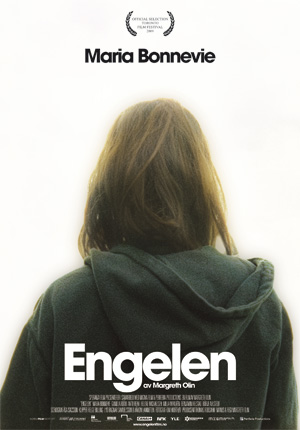 The bohemian country cottage becomes a wrong-side-of -the-tracks place of drinking and violence as Lea grows up, and the obsessive relationship poisons Lea’s hitherto well-balanced life, not least because of the love and protection she feels for her mother even when she continually chooses her life with Ole over the well-being of her own daughter. The big lesson of the film is not to make quick superficial judgements, as we understand how Lea’s decisions which at first seem selfish are in fact a kind of despairing altruism as she understands the importance of the good secure parenting she herself has lacked. Lena Endre’s uncompromising performance as the well-meaning but weak mother is particularly a tour de force.
MISSION LONDON [6/10]
Bulgaria/Hungary/Macedonia/UK 2010: Dimitar Mitovsky: 107m: Seen at Cinema Florin Piersic
Bizarrely this film became one of the talking points among the critics at TIFF, bringing forth the old debate of what constitutes ’a good film’. This crazy, broad farce which insults both its own Bulgarians and just about every other nationality involved was reviled in some quarters as a very bad film indeed, but it actually made me, and the audience, laugh a good deal, and that’s certainly a quality not to be sneezed at. Not that it comes into the category of ‘so bad it’s good’, a slightly disingenuous one I always think, where one shows one’s own superior sophistication at laughing at what a consensus has decided it’s smart to laugh at. One measure of a ‘good’ film to my mind is that it does what it sets out to do, and that this film certainly does, without pretention. The daft plot kicks off with the wife of the Bulgarian President wanting to take her ethnic dance troupe to England to perform a celebration of Bulgaria’s entering the EU, which she demands must be in front of the Queen. The humour may be scattergun, some of the acting a little wooden (though much of it spot on), but It’s fast, it’s irreverent, it’s absurd, involving the activities of the embassy’s lower orders illicit ’duty free’ shop, a dodgy celebrity look-alike business, some very bad taste, and a concatenation of misunderstandings and trickery culminating in a superbly silly performance night. Several British actors are involved, including David Collings as an amiable diplomatic drunk (and Rosemary Leach as… well that would be telling!) and I suspect the film would go down well over here.
REENACTMENT [8/10]
Reconstituirea : Romania 1969: Lucian Pintilie: 106m: seen at Cinema Florin Piersic
This year TIFF is showing a complete retrospective of the films of Lucian Pintilie, a director little known in western Europe but one who is named by many of the latest generation of Romanian directors as their inspiration. Reconstituirea is his masterpiece, voted by the Romanian Critics Circle as the country’s best film. Screened sporadically in Romania immediately after it was made but soon banned, it was shown in Cannes in 1970. Made under the strictures of Communism, it succeeds, remarkably, in presenting a critique of its political system with all the apparent verve and freedom and poetry of its contemporary Western European neighbours – and 1968/9 were the years of, for example, Weekend, Blow Up, Teorema, The Shame. Its special, very Romanian, ingredient is a sense of hopeless absurdity straight out of Ionesco.

In a drunken brawl two young lads have attacked and injured an older man. Officialdom has decreed that as their punishment and as a lesson to others it will film a reconstruction of the event with the same protagonists. Officials, film makers and the young offenders arrive at the run-down seaside area at which the event took place, where the good-natured victim is waiting. The total absurdity of the exercise is pointed up by a cheerful group of onlookers, including the classic insouciant pretty girl beloved of the Nouvelle Vague and a local teacher who philosophises bitterly about the situation, and acompanied by sporadic cheers from a nearby football game. Inconsequential happenings, including the escape and pursuit of an old lady’s geese, punctuate the action, as the re-enactment draws to its meaningless and ultimately tragic close. A feeling of despair, despite the many comic moments, pervades, as everything turns sour, and the arrival of the jubilant and curious football crowd brings an emotion which the passing years have made more poignant, as one looks at those ordinary people’s faces and knows what was in store for them. This is a film that certainly deserves wider recognition.
ODESSA IN FLAMES [6/10]
Odessa in fiammi : Italy 1942: Carmine Gallone: 85m: seen at Banffy Castle, Bontiţa
One of the highlights of my stay this year was a trip of about 20 miles outside Cluj to the village of Bontiţa and its decaying castle of Banffy. This part-renovated ‘Versailles of Romania’ is used as a training ground for students of reconstruction in the traditional ways of building, and is a staggeringly stately and striking location. As the sun set we drove along increasingly narrow roads passing through villages where storks had their nests, as old folk sat outside their cottages watching the world go by or watered their gardens, horses pulled the last of the day’s hay harvest home, village football games across the main street halted to let us by, and mists rose over the valleys. The film, shown in the open air under a half moon and with the stars emerging, could hardly have been more perfect for the location – a 1942 Venice Film Festival award winner full of melodrama, opera and grand scale wartime action. For many years thought lost, it was rediscovered at Cinecittà five years ago and splendidly restored. It’s basically a full-blooded propaganda film from Italy recreating the time in Bessarabia from 1940 to the siege of Odessa in 1942, when Romanian and German forces eventually took the city. Grandiose as all such films are, with famous Romanian soprano Maria Cebotari playing Maria Teodorescu, an opera singer who is separated from her husband and child by the ‘communist occupation’(actually an official arrangement as part of the German-Soviet Nonaggression Pact) , it’s chockful of sweeping panoramas of woeful refugees and victory parades, which are probably actual newsreel, sentimental family scenes, a wicked lady communist (who actually dresses more in the severe mode of wicked lady fascists), thwarted love, rather screechy operatic interludes belted out by La Cebotari, faithful retainers and spunky child actors. It’s all there, and powerful stuff it must have been at the time to Romanian nationalists. (Needless to say nothing is said of the subsequent massacre of 80% of the Jewish population of the region.) We enjoyed the silence afterwards under the stars, then took to the road again, passing one last late hay wagon drawn by white horses in the moonlight down the village street.
Sheila Seacroft
15th June, 2011
Cluj 2011 index-page
============================================================================
first dispatch (covering Reconstruction, The Angel, Odessa In Flames, etc)
second dispatch (covering The Turin Horse, Nokas, Stuff and Dough, etc)
third dispatch (covering Close To Heaven, The Corlat Valley, The Phantom Father, etc)
fourth dispatch (covering Life In A Day, Armadillo, Adalbert’s Dream, etc)