


Sheila Seacroft’s Cluj Dispatches (4) : LIFE IN A DAY, etc.
Part 4 : 11th-12th June
SHE MONKEYS [6½/10]
Apflickorna: Sweden 2011: Lisa Aschan: 83m: seen at Cinema Victoria
Emma (Mathilda Paradeiser) is a solitary, diffident girl living with her father and little sister. When she joins a team of horseback acrobatics she comes into the orbit of the beautiful, strong-minded Cassandra (Linda Molin), alpha female of the group, who takes up with her in a relationship which is fraught with psychological and sexual overtones. Best pals, leader and led, at first Cassandra calls the tune, but Emma learns fast and the power balance between the two shifts as it becomes evident that she likes, and is good at, being in control. Meanwhile, her little sister Sara (Isabella Lindquist) is having her own problems at a different stage of development. Told she must now wear a bikini top for swimming lessons, she chooses a sexy leopard-skin one, and proceeds to try to follow up a half-understood attraction to her cousin when he babysits. Confused? She certainly is, by the mixed messages put out to little girls. The big gap in their lives is lack of female role model (about the absent mother we know nothing) – the solitary Emma is driven by her ambition and learns on her feet, while all Sara has is Emma, with her talk of not showing emotion. Strong performances from the two lead teenagers and economical script where silences and glances count as strongly as words make this a heady blast of adolescent hunger and an intriguing study of power play, thankfully leavened by the half-comic half-serious plight of Sara, beautifully played by 8-year-old Isabella Lindquist.
ADALBERT’S DREAM [7/10]
Visul lui Adalbert: Romania 2011: Gabriel Achim: 101m: seen at Cinema Victoria
Once more Romanian Cinema mines its communist past for a drily funny tale of ordinary people just getting on with their lives. It’s not just any day at the factory for our shady but somehow admirable hero Iulica (Gabriel Spahiu), Health and Safety Chief, but the morning after the glorious victory of underdogs Steaua Bucharest in the European Cup over the mighty Barcelona – the only Romanian team ever to win it.. Everyone, or at least the men, really wants to be celebrating this, but in fact it’s Romanian Communist Party Day which is taking centre stage in the works canteen. Various lacklustre official events are on the cards, including a hilarious rendition of ‘The Power of Love’ by a stolid under-rehearsed factory choir, and a couple of official films Iulica’s made, one a warning about the perils of disrespecting Health and Safety, the other the eponymous Adalbert’s Dream, a clunky surreal effort, so named by Iulica ‘because it sounds like a foreign film’. Always on the dodgy edge of things, ever cheerful, Iulica the family man is also managing a rather unenthusiastic one-eyed mistress (star of his H&S film) and getting the factory to run him off a few little items for personal use, as well as possessing a possibly illicit video recorder, which he’s brought along to work to show the tape he’s made of the football to his boss when the festivities allow. Shot itself in the murky mode of that era, the film has its occasional longueurs, and sometimes the irony is a little too heavy, though one of its pleasures is that it never lets up on quirky and spirited details of factory camaraderie, and there are plenty of laughs. Finally the darkness really descends and the revels are ended when there’s a real accident in the factory, and a ‘re-enactment’ film has to be made about it to seek out where the blame lies and warn others. I gather this is a not uncommon phenomenon, as it’s also the basis of Pintilie’s Reconstituirea, shown earlier in the festival, another film that incidentally has a background leitmotif of the sound of a football crowd, again representing a unifying source of pleasure. A few weeks later the biggy in Health and Safety disasters was to happen, at Chernobyl.
THE SOLITUDE OF PRIME NUMBERS [5½/10]
La solitudine dei numeri primi: Italy 2010: Saverio Costanzo: 118m: seen at cinema Florin Piersic
Steel yourself for this feast of neurosis, guilt, despair, self-harm and misery. The Solitude of Prime Numbers is a relentlessly depressing tale of two people who repeatedly meet and part again after traumatic childhoods have made them solitary and strange. Not that they’re in love exactly, things would be easier if they were. Mattia, a loner carrying enormous guilt about his twin sister’s death and Alice, disabled by a skiing accident forced on her by an over-ambitious father and bullied at a school, cannot connect with others, but find an inevitable attraction, and the film shows them repeatedly coming together and drifting apart. With three actors playing each character at different ages and an ambitiously impressionistic style and attitude to the passage of time, it’s powerful but sometimes confusing and too intricate for its own good, though certain passages are masterly, especially in the earlier episodes. The splendid Isabella Rossellini as Mattia’s mother adds a steely credibility whenever she appears, but the relentless rather foetid air of doom and inevitability becomes overbearing towards the end, when it feels as if the film just doesn’t know where to go next or how to draw to a conclusion. By that time I’m afraid I’d had enough of this pair.
ARMADILLO [7/10]
Denmark 2010: Janus Metz Pedersen: 100m: seen at Cinema Victoria
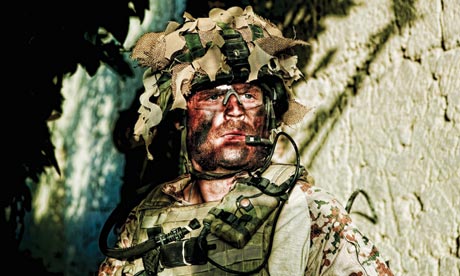
We might feel we’ve seen it all before, the fresh-faced soldiers going off to the Middle East to ‘keep the peace’, their last night at home, like a stag night, with strippers and drink, the sorrowful parting from loved ones at the airport, the bravado and the good intentions, the subsequent boredom in that almost monochrome landscape. But this is different – it’s, unbelievably sometimes, a documentary shot by a group of film-makers embedded in a platoon posted to Camp Armadillo in Helmand Province. The months are counted off as long stretches of inactivity are punctuated by fierce and dangerous fighting, and we watch as the boys toughen up physically and mentally, and eventually, inevitably, change. Many potent images: the deep-in-shock face of a just-wounded soldier; the bundle of clothes and human debris in a ditch that is a dead Taliban fighter; the cameras whirling in confusion under fire; the face of a very young soldier phoning home; the exasperated locals with remarkable good nature, telling these foreigners who say they have come to protect them, how their freshly ploughed fields have been flattened by tanks, or a year’s crops lost. Controversy was stirred back home when an incident in which several Taliban, maybe already wounded, are summarily killed by gunshot and hand grenades, and a possibly exaggerated report of this gets back to the Danish press, via a hyped up phone call home. Precisely what happened is unclear, though we do see one of the more gung-ho lads in an adrenaline-fuelled state back at camp describing his actions to his colleagues with relish. Not even an on the spot camera can capture the truth of what goes on in the fog of war. But can we be surprised when young men in a highly charged, potential kill-or-be-killed situation, react like this? And so inevitably the good intentions, the strength of the peace- keeping aims drop away, and what matters is belonging, looking out for ones’ mates, and proving oneself. This is what war is.
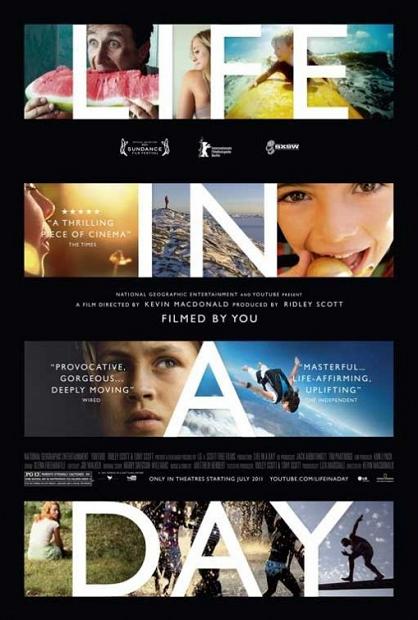
LIFE IN A DAY [7½/10]
United Kingdom 2011: Kevin McDonald: 95m: seen at Cinema Florin Piersic
Last year Kevin Macdonald put out the request for people to film a moment of their lives on the 24th July, and this montage, out of the 80,000 that were submitted, is the result. From all over the world, though naturally with a bias towards the video-owning developed world, come the little portraits of people, cleverly and subtly formed into a whole by Macdonald and editor, Joe Walker. The mood ranges and alters from the mundane (early morning bathroom activities) to the poetic (African women sing in harmony while preparing their food) through important life-events (a young man phones his grandmother to tell her he’s gay, a woman prepares for cancer treatment), to the trivial (a man tells of his love for his Lamborghini, people talk about what’s in their pockets). Many are endearingly sincere and heartfelt, some are amazing and moving, like the old-before-his-time little boy shoe-shiner from South America, some, hopefully, putting on a performance (please don’t let the guy reciting Walt Whitman to his baby be genuine). It’s the ordinary that fascinates, and other people’s ordinary can be so engaging. And if it’s mostly erring on the sunny side, there’s a huge downer towards the end, with the Love Parade disaster at Duisburg. Finally a girl tells her camera how she’s been waiting all day for something to film about herself, and now she realises that what she really wants is to let people know that she’s here. This was a great, relaxing, affecting choice for closing film at Cluj. Maybe, after the two harrowing efforts I’d sat through earlier in the day, as well as the accumulated weight of all the 24 films I’d previously notched up over the week, my critical faculties were shredded and just the sight of people being happy and funny as well as sad, and above all ‘normal’, was a relief so profound that I basked in pleasure. Sometimes that’s just what you want of cinema.
Sheila Seacroft
28th June, 2011
Cluj 2011 index-page
=======================================================
first dispatch (covering Reconstruction, The Angel, Odessa In Flames, etc)
second dispatch (covering The Turin Horse, Nokas, Stuff and Dough, etc)
third dispatch (covering Close To Heaven, The Corlat Valley, The Phantom Father, etc)
fourth dispatch (covering Life In A Day, Armadillo, Adalbert’s Dream, etc)