


Sheila Seacroft’s Cluj Dispatches (2) : THE TURIN HORSE, etc
 Part 2 : 8th-9th June
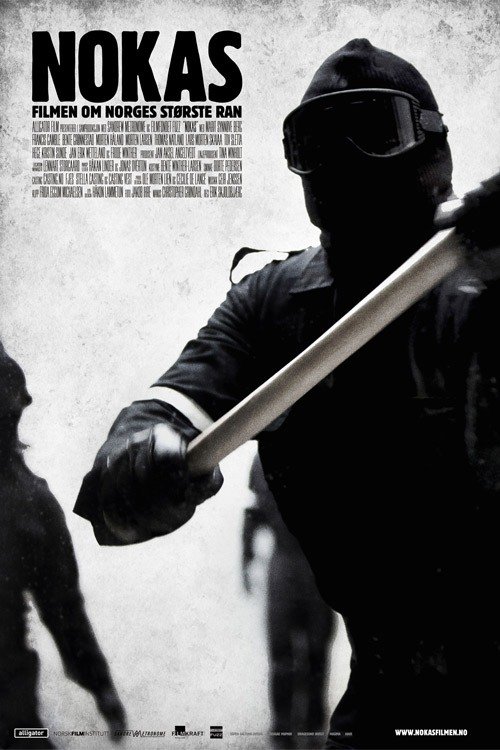
NOKAS [7/10]
Norway 2010: Erik Sjoldbjærg: 95m: seen at Cinema Florin Piersic
Maybe it’s because the small Norwegian city of Stavanger looks so mild-mannered and orderly that this painstaking reconstruction of an audacious bank robbery there that failed is so powerful. It’s told from eyewitness reports, in almost real time, on an ordinary, grey day. The robbers are buoyant and superficially confident that they will pull off the biggest bank robbery in Norwegian history; the police and bank workers are beginning just another routine day. Two serious miscalculations by the robbers turn the whole thing into a shambles: their optimism that they will have no trouble breaking through reinforced glass, and their belief that once the police see their pretty impressive array of weapons they will hold off. What follows is a grave and involving look at what happens to ordinary people confronted by the unexpected and the frightening. With a seriously undermanned and ill-equipped force on the day, a pair of young officers move straight from warning a bloke about his overloaded van to becoming the only police on the spot to confront highly armed and fairly chaotic robbers; passers-by can’t believe it’s real and continue to walk through the stand-off; a bus driver finds himself accidentally alone in the middle of the action, wondering, almost with embarrassment, what to do. (Afterwards, we are told, he finishes his shift as normal, though you know his life will never really be quite normal again.) The use of non-professionals gives a very naked look to these faces revealing desperate indecision, panic, but most often disbelief that this is happening in their life. No sides are taken, no judgements made –a frightened man is a frightened man whether he is a criminal, a policeman or a passer-by. We learn in the end that though the robbers were all picked up, only a small proportion of the stolen money was recovered, and you’re left wondering if it might not have been better all round had the heist worked as planned.
THE SILENCE [6/10]
Das letze Schweigen : German 2010 : Baran bo Odar: 118m: seen at Cinema Florin Piersic
Two murders, apparently identical, with 23 years between, form the centre of this slow-burning, intelligent thriller which circles round the perpetrators, the police, the victims and their families. Beginning with a bang with the almost dialogue-free rape and murder of teenager Pia, and witnessing the effect on Timo (Wotan Wilke Mohring), the shocked accomplice, we move swiftly to the present, where another girl of similar age, Sinikka, is killed on the same spot on the same date 23 years later. The police who were involved and failed to solve the crime eagerly take up the trail – recently retired Krischan (Burghart Klaußner)and the disturbed David (Sebastian Blomberg) whose wife has just died, the former seen by his ex-colleagues as a bit of an old duffer, the latter as a neurotic liability (who surely would have been firmly sent home on indefinite sickness leave by any real police force). For the first victim’s mother it is an ordeal she must revisit, and for the parents of Sinikka the nightmare is just beginning .Timo has moved away from his previous life and become a successful and happy family man. The tension builds simultaneously on the police’s official and unofficial investigations and on the question whether the guilt and knowledge of the identity of the murderer will drive Timo out of his new life to confess. Meanwhile Ulrich Thomson as the enigmatic murderer Peer, now seemingly a kindly caretaker, sends shivers down the spine as he sits by the children’s swing park and helps out old ladies. No crime is, maybe, as straightforward as it looks, and what has been thought of as a serial killing turns out to be more complicated, and the idyllic cornfield in which the two murders take place becomes a kind of timeless pivot for the action. Great beginning and end are rather let down by a long central section of overlong meanderings in regret, guilt and grief, but overall it’s a good mix of suspense and serious meditation on the many aspects of a crime.
THE TURIN HORSE [8/10]
A torinoi lo: Hungary/France/Germany/Switzerland 2011: Tarr Bela : 149m : seen at Cinema Florin Piersic
‘What is this darkness?’ is one of the few lines of dialogue spoken by the main female character, the Daughter (Bók Erika), towards the end of this film. It’s always the question in Tarr films, and it’s a question which has no answer. The darkness that has been edging in and finally becomes all-enveloping is both metaphorical and actual in this exquisitely beautiful, difficult film. Winner of the Jury Grand Prix at Berlin, it has divided critics and audiences, and it’s divided me. Arduous yet stimulating, beautiful yet ugly, boring yet gripping, you ache for it to end but you don’t want it to stop. Is it a kind of masochism that makes you ‘enjoy’ its ruthless depiction of a both physically and spiritually hard life that has no meaning and no future? Did it need to be quite so long, or is that just a habit, a kind of tic Tarr has acquired?
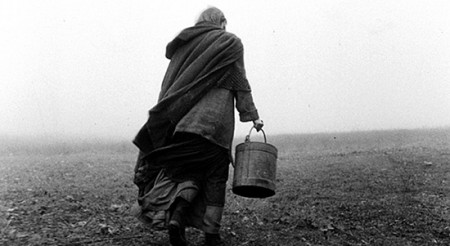
Eleven years before his death, the philosopher Nietzsche, while staying in Turin, suffered a breakdown, from which he never recovered, after witnessing a horse being beaten in the street and intervening to protect it. Tarr gives us a version of the horse and its owners, not in the city but in the countryside where the carter (Dzersi Janós) returns to the bleak isolated cottage where he lives with his daughter. The sheer labour of their lives, each day the same routine, everything a physical effort without emotion, every banal act – dressing and undressing, fetching water, harnessing the horse – performed with a kind of desperate, bored compulsion, their only food potatoes which they gobble while too hot then listlessly abandon. They remain unknown, hardly characters at all, receptacles for suffering. Silence, the sound of the fierce wind, and a repetitive, hypnotic score that’s almost unbearable to listen to, alternate. The horse (Ricsi) is tremendous, a huge, muscular physical presence, a symbol of mute suffering but somehow imbued with a kind of weary knowledge deeper than that of the humans. As gradually the necessities of life – livelihood, water, heat and light – vanish, both escape and continuation of life there is impossible, and we and Father and Daughter are left in the great darkness. Tarr has declared that this is his last film.
1001 IRANS [6½/10]
Iran/Spain/Italy 2010: Firouzeh Khosrovani: 43m: seen at Cinema Arta
Iranian director Khosrovani was fascinated by the many and often faulty perceptions of her country in the west, and this short film is her attempt to bring these together for scrutiny. In Italy, Tenerife, the United States, England, and Spain she asks people on the streets to tell her what they know about Iran, and a surprisingly lyrical, poignant little film is the result. Not just militant Islam, war, repression of women, and a general confusion with the wider Arab world, but the food, cinema, gardens, and a generalised romantic orientalism – are evoked by the variety of passers-by spoken to. There are surprises: the young Roman fisherman who mentioned the ancient civilisation and Gilgamesh, the open-mindedness and general warmth, despite the bad press which is pretty general throughout western Europe. The shame is that this film, so enlightening and in many ways encouraging, cannot be shown in Iran itself.
GRANDE HOTEL [7/10]
Belgium 2010: Lotte Stoops: 70m: seen at Cinema Arta
In 1955 the then thriving Portuguese colony of Mozambique presented an opulent face to the world. The Grande Hotel in the small seaside town of Beira was built on a grotesque scale of lavish wealth that even then was almost farcical. A great white fascist-deco style monument to colonialism, more a small town than a building, with hundreds of bedrooms, casinos, shops, restaurants, pools and sports areas, it was a haven of luxury for the white colonists and tourists who could afford to holiday there. But a mere 11 years after opening its life as a hotel was over, and a long period of decay set in, as the country descended into civil war, squatters moved in and the pool became a washing area, the public rooms seedy gambling dens and brothels, churches and mosques, and the guest rooms homes for multiple families. Lack of sanitation, hit and miss water supply, crime and physical decay might make this seem a nightmarish and downright dangerous place to live, but against the odds a system of rudimentary organisation has the living areas divided into blocks, each with its ‘chief’ trying keep some order and make the best of things for its occupants.
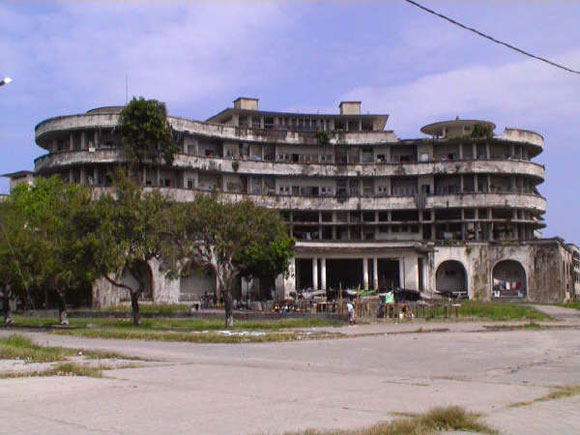
One of these is our guide to the labyrinth, the cheerful Moises, who leads us through the crumbling concrete, meeting friends and sorting out problems along the way. The building is dying, as people chip away lumps of the infrastructure to sell, and trees break up the walls, but the goodwill, invention and resilience is striking. It’s impossible not to see the place as a metaphor for the follies and death of colonialism, but the casualties have been on both sides, for there’s another voice, that of an elderly white woman, which gives the alternative view of the hotel as it is in her memories, a beloved place she will never return to, the dream of a beautiful Africa for the deluded white minority for whom it really was the only home they knew.
DIFFERENT MOTHERS [5/10]
Despre alte mame: Romania 2010: Mihai Ionescu, Tiberiu Iordan: 83m: seen at Cinema Victoria
I really wanted to like this film. It’s a good idea – five young men spend a day in a train station filming the life that goes on there, hanging out, discussing their lives, telling jokes, meeting characters, complaining about the cold. At the end of the day, Blow Up fashion, it turns out that in the background of their shots they have unknowingly filmed something significant to the police. This is apparently something that happened to Krysztof Kieslowski when making Station in 1981, and was the inspiration for the film. The problem is that a good deal of it is quite dull. The characters, though likeable, are not fully formed, their talk not interesting (though this could be partly a problem for non-Romanian-speaking audiences – the local audience seemed to be enjoying it more than me). I finally warmed to the lads, but only after a rather long period of not really feeling interested in either their filming or their personal lives. The other major flaw seemed to me to be the ‘mothers’ motif – the guys do talk a little about their mothers, sure (in one enjoyable section they discuss how the worst swearing almost always involves insults to mothers), but it is rather welded on as a theme, and feels particularly artificially injected into the revelation at the end. That’s not just unconvincing, but a huge missed opportunity – by making the crime they have unwittingly provided evidence about so gross, they have missed the chance to open up the characters to a multitude of ethical questions. Even so, it’s an amiable enough piece, and there’s enough promise here to hope that the directors will develop something stronger next time.
VOLCANO [7/10]
Eldfjall: Iceland 2011: Rúnar Rúnarsson: 99m: seen at Cinema Victoria
A film for grown-ups, dealing with the shock of retirement, the lost intimacies of marriage, isolation and the mundane facts of serious illness, Volcano impresses and involves from the outset. Hennes (Theódor Júlíusson), a man who’s good at telling people what not to do, is retiring from his job as school caretaker as we first meet him. Dislikeable, on bad terms with his children and apparently uncaring of his wife, he’s actually a volcano of rage and self-hate within, and even contemplates suicide. The dour and spectacular landscapes and seas of Iceland echo his inner state of misery. The realisation that he does not really want to die is reinforced when, out fishing, his boat almost capsizes.
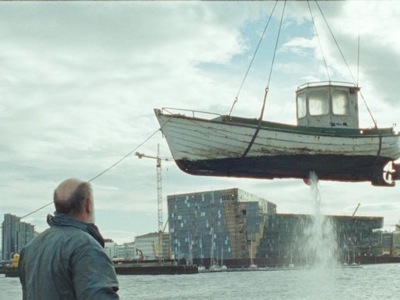
Thereafter he begins a slow steady climb back into the warmth and pleasure of relationships, only to have everything taken away. Matter of fact scenes of caring for the terminally ill are hard to watch, though younger audiences may feel more squeamish at the elderly sex. And if this all sounds grim, well it is, but never for a moment self-indulgent or sentimental. Depression and despair in older people are less immediately ‘attractive’ subjects than in the young, nor are the cataclysmic illnesses of old age an easy subject. It’s a very impressive, thoroughly engrossing, first feature film from Rúnarsson, definitely a director to watch.
STUFF AND DOUGH [7½/10]
Marfa şi Banii: Romania 2001: Cristi Puiu: 90m: seen at Cinema Florin Piersic
Cristi Puiu’s second feature, The Death of Mr Lăzărescu, was the film which kick-started the outside world’s interest in Romanian cinema. Yet, recipient of several awards from Thessaloniki to Buenos Aires four years earlier, Stuff and Dough was surely an intimation that the Romanians were coming. After a day of fairly gruelling films, I suppose there was extra pleasure in watching what for a good deal of its course is a freewheeling road movie full of the joys and optimism and light-hearted bickering of youth, even if that optimism is categorically scuppered by the end of the film. Oliviu (Alexandru Papadopol), fancies himself a wheeler dealer in his provincial town and thinks he has found a nice little earner to make enough money on the side to buy his own kiosk, his modest ambition. He blithely accepts a job for the local Mr Big ferrying ‘stuff’ to Bucharest, and seeing it as a bit of a fun trip takes his rather ditzy pal Vali (Dragoş Bucur), who in turn brings along his bored girlfriend Bety (Ioana Flora). But things don’t exactly go to plan, the ‘stuff’ is more complicated than they expect, and by the end of the film Oliviu and Vali realise they’re into something much bigger and more dangerous than they ever imagined. The naturalistic acting is exceptionally deft; Dragoş Bucur and Luminiţa Gheorghiu, who plays Ovidiu’s long-suffering mother, both subsequently became stars of several of the ‘new wave’ Romanian films. Shot mostly in the car’s interior and on location in the streets, all on a small budget, it’s an accomplished tale of death of innocence, as we see Oliviu and Vali grow up before our eyes, but also has tremendously enjoyable verve along the way.
Sheila Seacroft
20th June, 2011
Cluj 2011 index-page
=========================================================
first dispatch (covering Reconstruction, The Angel, Odessa In Flames, etc)
second dispatch (covering The Turin Horse, Nokas, Stuff and Dough, etc)
third dispatch (covering Close To Heaven, The Corlat Valley, The Phantom Father, etc)
fourth dispatch (covering Life In A Day, Armadillo, Adalbert’s Dream, etc)