


Sheila Seacroft’s Cluj Dispatches (3) : CLOSE TO HEAVEN, etc.
Part 3 : 10th June
A wild, rainy morning makes walking around Cluj a bit of an adventure, controlling the umbrella in the fitful wind and dodging the sometimes man-high showers of murky puddle-water sent up by passing cars and buses in some of the busy streets. A good day to hole up in the Victoria Cinema for a morning of Romanian documentaries.
CLOSE TO HEAVEN [8/10]
Aproape de cer: Romania/Germany2010: Titus Faschina: 93m: seen at Cinema Victoria
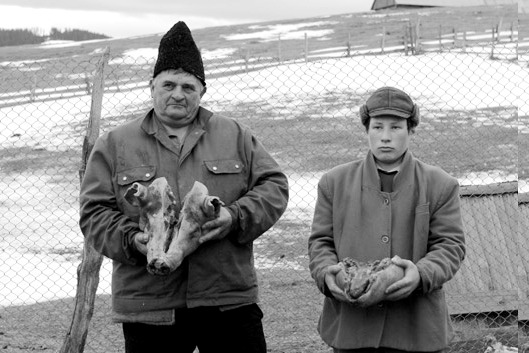
This serene and moving documentary was by far the most beautiful film I saw in the festival. In lustrous black and white, it tracks a year in the lives of the Stanciu family, parents and son, who farm sheep high in the Carpathians. Close to heaven, but a life of hard graft and thudding repetition. It’s a way of existence that’s very quickly dying, and they are now one of the few families still using traditional methods which a combination of EU regulations about food production and urbanisation are killing off, so this as well as being a fine poetic film is an important archive document of a way of life that in the next generation will almost certainly have disappeared. Faschina has coaxed wonderfully unselfconscious conversations from the three: father a philosophical and laconic teller of tales and pragmatic worker, almost mythical in his vast sheepskin jacket; mother, cheerful but perhaps the least contented and most aware of their knife-edge situation, with her many anxieties – about illness, ageing, isolation, what her son will do with his life, and just the hard, unremitting graft of day to day. Most poignant is Radu the young teenage son, an open-faced, shy, smaller copy of his father, who, amazingly, seems the most contented with his lot. We track him on his long walk through meadow and wood to the village and bus to school, where he is studying veterinary health, his ambition to become a sheep farmer too. Meanwhile the camera soars across the beautiful, sheep-dotted hills, the ruined neighbouring farms, now all empty, the wind-shaped single trees planted so long ago for shepherds to shelter from the midday sun in a simpler world.
THE CORLAT VALLEY [6/10]
Valea Corlatului: Romania 2011: Stéphane Luçon: 53m: seen at Cinema Victoria
There’s a settlement in the Corlat Valley, where a stream forms a boundary between a Hungarian and a Romanian-led council, which doesn’t seem to belong anywhere. Its inhabitants are mostly Roma, whom nobody wants, particularly the Hungarian side, who claim they keep popping over the bridge to thieve and fight and cause trouble. Bland officials talk the bureaucratic talk about their problems, while the impoverished Roma try to get on with their lives, arguing the toss about benefits at the post office and making do with ramshackle housing without electricity or water. They have no identity cards or addresses because the houses where they live do not officially exist. They’re not without a sense of the ridiculous themselves – ‘it means a romantic candlelit dinner every night’, says one young woman, ‘not many people get that.’ It’s a microcosm of the world’s treatment of the Roma, but told with humour and sometimes Pythonesque absurdity: the mayor’s phone that keeps on ringing to the point of insanity during an interview; the increasingly desperate shuffling off of responsibility on the faces of the officials. Daftest of all is the proposed solution: the river is to be ’relocated’, (with suitable bogus scientific evidence that it has moved over the millennia and is in the ‘wrong place’) to put the Roma firmly into the Romanian camp, canalised and walled in so the bridge, hitherto a mere step across, can be built high and police-able. If it wasn’t so funny you’d cry. But it is, grimly funny, and all the more potent for that.
24 BUCKETS, 7 MICE, 18 YEARS [7/10]
24 galeţi, 7 şoareci, 18 ani: Romania 2011: Marius Iacob; 42m: seen at Cinema Victoria
This zany title is soon explained: the eccentric subjects of this delightful documentary are obsessed with winning the lottery, and will use any ‘significant’ number that comes into their heads out of their daily life to bring luck. It’s all very scientific – if the number’s too big, they’ll add up the digits and use the total. For a while it’s a puzzle what this grimy pair do for a living out in the dusty countryside with their steaming heap and their shovels, but it gradually becomes clear they are charcoal burners, the people who make the barbecue blocks for the more affluent to play at al fresco living. Not just that, they have become a tourist attraction, and visitors from all over the world come on horse-drawn carts to visit this phenomenon and be photographed shovelling the steaming coals or arm in arm with the amiable couple. Chatting in French or joining in a song with a cheerful American lady (the man has an excellent voice), they’re charming hosts, but when the crowds have gone away and their raking and poking of the day has finished, they’re back at their number divination, adding up the number of buckets they’d gathered, or years they’ve been married, or sum of their ages, with deadpan enthusiasm, punctuated by a song from him or a reading aloud of a newspaper story from the alien outside world by her. This urge to get rich and get away has a strange dispassionate, cheerful compulsion about it, and you’re never sure how much real yearning lies beneath. Deft direction makes this a tender and sympathetic portrayal, despite the fun, and they linger in the mind as fascinating human beings of humour, resilience and more than a touch of quiet desperation.
PRINCIPLES OF LIFE [7/10]
Principii de viaţă: Romania 2010: Constantin Popescu: 97m: seen at Cinema Florin Piersic
By far the best new Romanian feature film I saw, this was joint winner (with Rúnar Rúnarsson’s Volcano) of the Director’s Prize here. Velicanu (Vlad Ivanov) appears to be a successful man. He likes to be in control, and his self image is impressive: smart flat and young second wife with toddler son, successful printing business, new villa half-built, good terms with his ex wife and teenage son Cătălin… But success is hard to manage, as he plans to leave on holiday with his young family, taking Cătălin with him for a bit of quality bonding time fishing. The little irritations build up, from small to large, as he finds his parking space taken, has to toe the line at the supermarket, deals with a finicky customer, and has trouble getting Cătălin to show much enthusiasm. It’s a clever touch that Ivanov’s portrayal of Velicanu wins us over to his side so often with his mundane battles with the world, even while we can see his hubris. But what begins as almost a comedy of manners builds into something a deal more serious as Cătălin’s casual standard teenage behaviour blows Velicanu’s facade of control and happiness apart, and the smiles are wiped off our faces in short order. It’s a pleasure to see a film that conveys the truth that many Romanians live lives that are not that different from the rest of the western world, that doesn’t relate to specifically Romanian problems, that doesn’t hark back to the Communist era, that doesn’t thrive on exotic quaintness or ‘Balkanism’…
THE PHANTOM FATHER [2/10]
Tatal fantoma: Romania: Lucian Georgescu: 90m: seen at Cinema Florin Piersic
… unlike this one. I saw only two films at TIFF which I actively disliked, both unfortunately Romanian, one of them this. For what it’s worth, it’s about American academic Robert who wants to trace his family, back in Romania. His father was a writer, but his uncle a racketeer who spent much of his life in prison (the McGuffin). Coming over he meets beautiful archivist Tanya (the love interest), and together they go (the scenic bit) in search of cuddly old man Sami, a projectionist (the romantic Cinema Paradiso bit) whose cinema has been closed (the sad bit) by the evil mayor and his Russian henchmen (the thriller bit) and who is projecting his films in the open air from a van around the country (the nostalgic bit). The logic of the plot goes a bit AWOL as Sami turns up back at his cinema and reveals to Robert that his family were in fact very rich and ‘owned the city’ (the hard to believe bit), so all Robert has to do is open the cinema again and go off with Tanya on a motorbike into the sunset. It’s not so much that it’s preposterous, as that it’s sloppy and badly scripted, grabbing at many a cinema cliché along the way for effect, illogically edited, and just not good.
To get the bad ones over with I’m dodging chronology to bring you my second turkey, actually seen on the following day…
IF THE SEED DOESN’T DIE [3/10]
Daca bobul nu moari: Romania: Sinişa Dragin: 113m: seen at Cinema Florin Piersic
This is full Balkan madness writ large and hysterical. Two fathers are looking for their offspring: one for his daughter working as a prostitute in Serbia, the other for the body of his son killed in a car accident. They meet crossing the Danube, where the boatman tells them the story of a wooden church which was moved by its parishioners across a valley and up a hill, only to be caught in the floods and half-inundated. This image constantly laces the narrative and at least provides moments of calm repose in the unremitting chaos of their searches , a feast of manic, sweaty grimacing and disasters which can only end in tears, even descending at the end to gratuitous incest, a step too far and wildly unnecessary. The only redeeming feature is the cinematography, which does bring some beautiful images, and makes one think that, just maybe, if the director could calm himself down and stop thumping the audience in the face, there might be hope for future projects.
LOVERBOY [5½/10]
Romania/Sweden/Serbia: Cătălin Mitulescu: 93m: seen at Cinema Florin Piersic
This much anticipated feature from the director of How I Spent the End of the World doesn’t have the feel of real truth that stood out so in that first feature. And while it must be applauded for tackling a subject, sex trafficking, that is very much of the here and now in Romania, the film is as much a personal tragedy and maybe a discourse on love as a look into the sex trade and what it really means. Luca (George Piştereanu), the Loverboy of the title, is a charming, baby-faced wide-boy who seduces young naive women so as to sell them into prostitution, a middleman to the sex traffickers in a Constanţa, a now mostly run-down resort on the Black Sea coast (which briefly many years ago was an unlikely package destination for western European tourists). Smart and slick and a free spirit on his scooter, he easily gets the girls’ confidence, though he’s running close to the wind as the police have their eye on him. Does he have a conscience? Difficult to say, but when he actually falls in love with Veli, a girl from the country, things begin to change for him, and for a moment when she leaves her conservative family to be with him it seems he might be redeemed and live the simple life she imagines for them both. But the old life and its debts catch up with him, and spouting his mantra ‘Sex doesn’t matter’, Veli starts to sell herself to his acquaintances to help him out. Has she been corrupted too? Has Luca realised that sex does matter, or is he reverting to type? Personally I didn’t believe in this final section of the film and quite what we are meant to take away from it I’m not sure.
Sheila Seacroft
20th June, 2011
Cluj 2011 index-page
=================================================
first dispatch (covering Reconstruction, The Angel, Odessa In Flames, etc)
second dispatch (covering The Turin Horse, Nokas, Stuff and Dough, etc)
third dispatch (covering Close To Heaven, The Corlat Valley, The Phantom Father, etc)
fourth dispatch (covering Life In A Day, Armadillo, Adalbert’s Dream, etc)